
Travelling abroad for medical treatment raises a lot of questions — and the people asking them deserve straight answers, not marketing. This page collects the 25 questions patients ask us most often before they travel to Kathmandu, grouped by topic, answered as plainly and honestly as we can.
Where something is uncertain, depends on the individual, or is genuinely a risk, we say so. If your question isn't covered here, message us — we'd rather you ask than guess.
How to use this page: tap any question to open the answer. The questions are grouped into six sections: safety and quality, costs and payments, travel, treatments, recovery and aftercare, and how MediTour Nepal works.
🛡️ Safety & Quality
The questions that matter most — and the ones we think deserve the most candid answers.
1. Is medical tourism in Nepal safe?
It can be — but safety depends on the clinic and surgeon you choose, not just the country. All surgery carries risk wherever it's performed. At a properly qualified, well-equipped clinic with an experienced surgeon and sound aftercare, the risks are broadly comparable to a reputable private clinic at home. At an unvetted, low-cost clinic anywhere in the world, they are significantly higher.
That is exactly why vetting matters, and why we only work with clinics we have assessed in person. We can't promise a perfect outcome — nobody honestly can — but we can promise you will not be choosing a clinic blind.
2. How does MediTour Nepal vet its partner clinics?
We look at the things that actually affect your outcome: the surgeon's registration and training, the equipment and implant or laser brands used, sterilisation and infection-control standards, experience with international patients, written warranty and aftercare terms, and how quickly and clearly the clinic communicates.
We visit and assess clinics in person rather than simply listing them. A clinic that can't or won't answer these questions clearly does not become a partner.
3. Are Nepal's clinics regulated and accredited?
Doctors and dentists in Nepal must be registered with the Nepal Medical Council or the relevant professional body. However, regulation of the private cosmetic and elective sector is less developed than in the UK, and Nepal has far fewer internationally accredited (for example JCI) hospitals than countries such as Thailand or India.
For elective treatments such as hair transplants, dental work, LASIK and cosmetic surgery, the practical benchmarks are the surgeon's credentials, the equipment, and the clinic's protocols — which is where our vetting focuses. For complex procedures such as cardiac surgery, an internationally accredited hospital elsewhere may be the better choice, and we will tell you so.
4. Are the surgeons and dentists properly qualified?
The specialists at our partner clinics are registered in Nepal, and many have trained or practised in the UK, India, Europe or the US. We check credentials rather than relying on marketing claims.
We encourage every patient to ask their assigned specialist directly about their training, how many procedures like yours they perform, and to see before-and-after results. A good surgeon welcomes those questions.
5. What if something goes wrong during or after treatment?
Complications are uncommon with elective procedures at a good clinic, but they can happen anywhere. If an issue arises while you're in Kathmandu, your surgeon and MediTour coordinator are on hand to manage it. After you return home, your Nepal clinic remains available for telemedicine follow-up, and can send a clinical summary to a doctor near you if you need in-person care.
This is the strongest reason to buy specialist medical travel insurance that covers complications and extended stays — standard travel insurance usually does not. See question 15.
💷 Costs & Payments
What it really costs, and how you pay.
6. How much cheaper is treatment in Nepal?
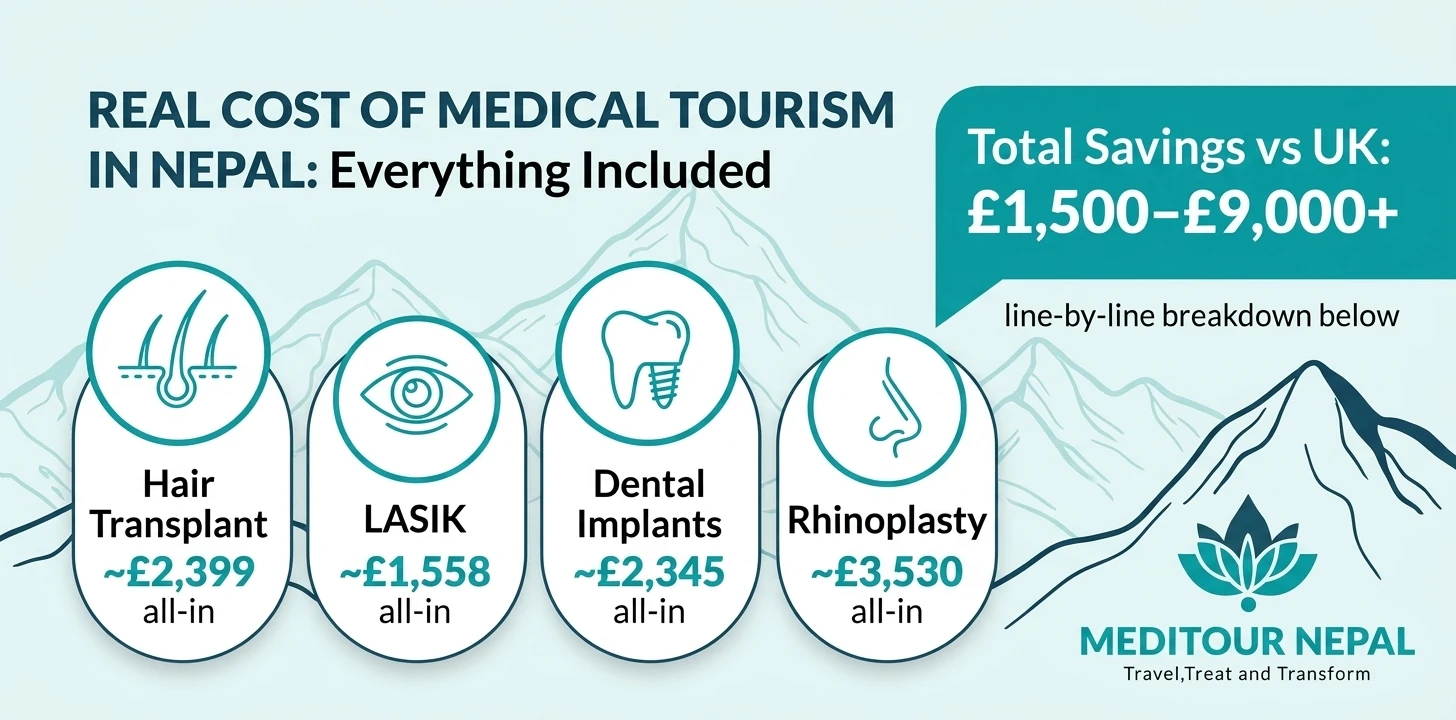
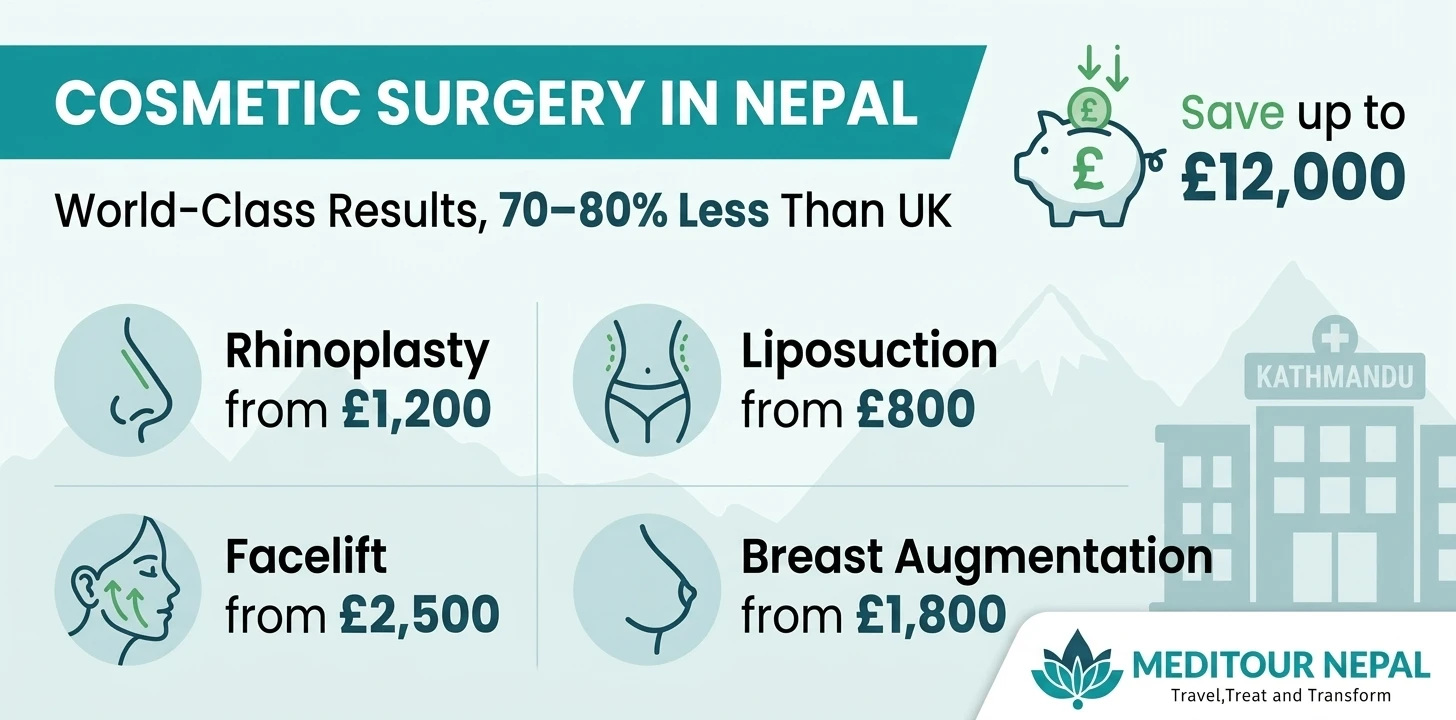
For most elective treatments, procedure costs are around 70–85% lower than in the UK, US or Australia. Typical examples: a hair transplant from about £700–£1,500 versus £5,000–£9,000 in the UK; a dental implant from about £350–£650 versus £1,900–£3,500; LASIK for both eyes from about £300–£600 versus £2,000–£5,000.
These are indicative ranges. Your exact quote depends on your case, the technique, and the clinic, and we give you an itemised quote before you commit to any travel.
7. Are there hidden costs I should know about?
The procedure quote from our partner clinics is itemised in advance, so there should be no surprises on the day. The costs people most often forget are outside the clinic bill: flights, accommodation, food, local transport, your visa, and travel insurance. For a week-long trip, these typically add roughly £1,000–£1,600 for a UK patient.
Even with everything included, the total is still usually thousands of pounds below home prices for larger procedures — though for smaller treatments the saving is narrower, and we'll say so honestly.
8. How do I pay for treatment?
Payment is made to the clinic, usually by bank transfer, card or cash. A deposit is commonly required to secure your booking date, with the balance paid on arrival or at the clinic. Major currencies, particularly US dollars, are widely accepted, and Visa and Mastercard work at most partner clinics, sometimes with a small processing fee.
Some clinics offer staged payment for larger treatment plans — ask your coordinator what is available for your case.
9. Do I need to pay a deposit, and is it refundable?
Many clinics ask for a deposit to hold your treatment date. Refund terms vary by clinic and by how much notice you give, so we make sure the deposit amount and cancellation terms are clear in writing before you pay anything. Never pay a deposit without understanding what happens if you need to cancel or if the clinic advises that you are not a suitable candidate after assessment.
10. Does MediTour Nepal charge patients a fee?
Your quote, assessment and coordination support are free to request. MediTour Nepal is paid through a referral arrangement with its partner clinics. We believe you should know that, because it means we have a commercial interest in patients choosing treatment — which is why we encourage you to ask for an itemised quote, compare it against other options, and only proceed if it is right for you.
If a treatment isn't suitable for you, or Nepal isn't the right destination for your procedure, we will say so.
✈️ Travel
Visas, flights, timing and insurance.
11. Do I need a visa to enter Nepal for treatment?
Citizens of the UK, US, Australia, Canada and most European countries can get a tourist visa on arrival at Kathmandu's Tribhuvan International Airport. A 30-day visa costs USD $50, paid in cash at the airport, and you'll need a passport valid for at least six months and passport-sized photos. No separate medical visa is required for elective treatment.
Visa rules can change, so always check the current requirements for your nationality before you travel. Your coordinator will confirm them for you.
12. How do I get to Kathmandu, and how long does it take?
There are no direct flights from the UK, US or Australia. Most patients connect through Doha, Dubai, Abu Dhabi or Delhi (from the UK and US) or Bangkok, Kuala Lumpur, Singapore or Delhi (from Australia). Total journey time is typically 10–12 hours from London with one stop, and 12–16 hours from Sydney or Melbourne.
Return fares from London commonly run £450–£750; from Australia, roughly A$1,200–A$1,600. Book flights only after your treatment dates are confirmed.
13. When is the best time of year to go?
October–November and March–April are the best windows: clear skies, comfortable temperatures, and a lively cultural calendar. December–February is cool and quiet with lower fares. June–September is monsoon season — wetter and more humid, but treatment goes ahead as normal.
Peak seasons fill clinic calendars quickly, so book four to six weeks ahead if you can.
14. How long will I need to stay in Nepal?
It depends on the treatment. As a guide: LASIK about 5–7 days, hair transplant about 5–7 days, dental work from 3 to 7 days (implants may need a second visit), cosmetic surgery 7–14 days depending on the procedure, and IVF around 10–14 days for the key phase. Your coordinator will plan a precise itinerary for your case — and tell you honestly if your surgeon wants you to stay longer before flying.
15. Do I need travel insurance, and will standard cover be enough?
You should not travel for treatment without insurance — but standard travel insurance usually excludes pre-planned elective procedures and their complications. You need a specialist medical travel insurance policy that explicitly covers your procedure, complications, and any extended stay or emergency return flight.
Cost is typically around £60–£120 for a week's cover. Australian patients should also note that Medicare does not cover treatment received overseas.
🦷 Treatments
What's available and what to expect.
16. Which treatments does MediTour Nepal arrange?
Our focus is elective treatment: hair transplants, dental care (implants, veneers, crowns, full-mouth work), LASIK and laser eye surgery, cosmetic surgery (rhinoplasty, liposuction, facelifts, breast augmentation and more), and IVF and fertility treatment.
We do not arrange complex cardiac, cancer or transplant care — for those, other destinations with larger accredited hospitals are usually a better fit, and we're happy to say so.
17. Can I get a quote and assessment before I travel?
Yes — and we strongly recommend it. Send your photographs, X-rays or scans and medical history, and a specialist at a partner clinic reviews your case and sends a written, itemised quote. This remote assessment is free and carries no commitment. You should never book flights before you have a written quote and a clear view of whether you're a suitable candidate.
18. Can I combine more than one treatment in a single trip?
Often, yes. Common combinations include a hair transplant with PRP therapy, dental work alongside a hair transplant, or several cosmetic procedures together. Combining treatments can save on flights and accommodation, but your surgeon will confirm what is safe to do together — some combinations are not advisable in a single stay.
19. Is IVF legal in Nepal, and do you arrange surrogacy?
IVF is legal in Nepal and is offered by established fertility clinics, including donor egg programmes operating under ethical guidelines. We do not arrange surrogacy: surrogacy arrangements involving foreign nationals are legally uncertain in Nepal, and we focus solely on IVF cycles using a patient's own eggs or regulated donor programmes. Laws change, so always confirm the current position before making any decisions.
🌿 Recovery & Aftercare
Healing, flying home, and follow-up.
20. How soon can I fly home after treatment?
It depends entirely on the procedure and your individual healing, and your surgeon makes the call at your final check-up. As a rough guide: LASIK patients are usually advised to wait at least 48 hours, hair transplant patients around 3–4 days, many facial cosmetic procedures 7–10 days, and body-contouring surgery 10–14 days. Never cut your recovery time short to catch an earlier flight.
21. What aftercare do I get once I'm back home?
You leave Nepal with written aftercare instructions and any prescribed medication. Your surgeon remains reachable by WhatsApp and video call for follow-up questions, and many clinics schedule check-ins at set intervals (for example at 1, 3 and 6 months after a hair transplant). MediTour Nepal stays in touch to make sure you are healing as expected and can help coordinate with your clinic if concerns arise.
22. Can I bring a partner or friend with me?
Absolutely, and for larger procedures we encourage it. Having someone with you during recovery is valuable, and Kathmandu has plenty to occupy a companion while you're at appointments. We can help arrange accommodation for two and suggest activities. For IVF, the male partner usually needs to be present on the day of egg retrieval. Many patients also travel alone and tell us they felt well supported.
🏔️ How MediTour Nepal Works
What we do, and what we don't.
23. What exactly does MediTour Nepal do?
We act as your coordinator and advocate. In practice that means: reviewing your case and matching you with a suitable clinic and specialist, obtaining an itemised quote, advising on visa, flights and accommodation, meeting you at the airport, arranging clinic transfers, being with you on key appointments, checking in daily during your stay, and staying in contact after you return home.
We are not the medical provider — your treatment is carried out and billed by the clinic.
24. What is your process from first enquiry to treatment?
1. You request a free quote and share your goals and medical details. 2. A specialist reviews your case and we send an itemised written quote. 3. You decide, ask questions, and confirm dates if you wish to proceed. 4. We help with travel logistics and arrange your pick-up. 5. You attend your assessment and treatment in Kathmandu with your coordinator alongside you. 6. We follow up after you return home.
You can stop at any point before you commit, with no obligation.
25. Is MediTour Nepal right for me if I'm travelling alone or have never done this before?
That's exactly who the service is designed for. English is widely spoken by our coordinators and clinic teams, so language is not a barrier, and having a dedicated person meeting you, accompanying you and checking in daily removes most of the stress of an unfamiliar destination. If after talking to us you decide medical travel isn't for you, that is a perfectly good outcome too.
Medical tourism is a real option with real savings, but it is not right for everyone and it is never risk-free. Take your time, get a written quote, ask difficult questions, compare your options, and speak to your own GP if you have any health conditions. The best decisions are the unhurried ones.
Still Have a Question?
Ask us anything — there's no obligation. Send your details for a free, itemised quote, or message us on WhatsApp and a real person will reply.