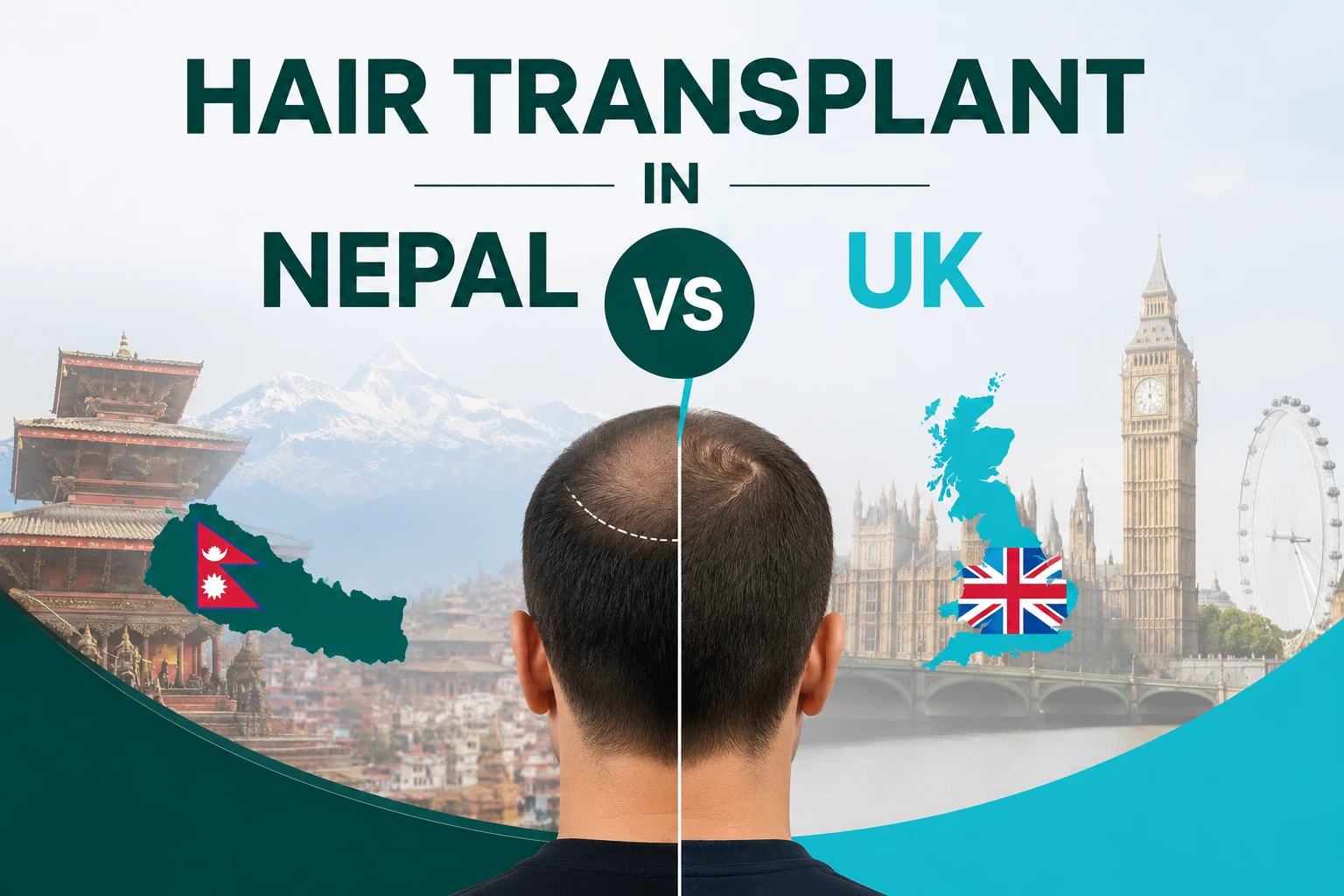
Hair loss affects millions of people across the UK and around the world. For many, a hair transplant is the most effective and permanent solution — but with UK prices regularly reaching £7,500 to £10,000 or more for a single FUE session, it is simply out of reach for the majority of patients.
That is why growing numbers of British, American and European patients are turning to Nepal — a destination that combines internationally trained surgeons, modern equipment and dramatically lower costs, all set against the backdrop of the Himalayas.
In this guide we break down everything you need to know before booking: the real cost difference, what the quality is actually like, the techniques available, what to expect on the day, and how to travel to Nepal for your procedure safely and confidently.
🏔️ Quick summary
A 2,500-graft FUE hair transplant that costs £8,000–£10,000 in the UK typically costs $1,500–$2,500 (approximately £1,200–£2,000) in Nepal — performed by surgeons trained to the same international standard, using identical techniques and equipment. The savings are real.
The Cost: Nepal vs UK Side by Side
Let us start with the number most people search for first. The average cost of a hair transplant in the UK typically ranges from £3,000 to £15,000, depending on several factors including the extent of hair loss, the technique used, and the clinic's location and reputation. FUE procedures can start from around £4,000 and reach £15,000 for larger sessions.
On average, a UK hair transplant costs £4,820 for a 1,500 graft procedure, with the average cost-per-graft in the UK sitting at £3.25. For a more comprehensive 3,000-graft session — which is what most patients with moderate to advanced hair loss require — the UK total often exceeds £9,000–£10,000.
In Nepal, the picture is dramatically different. The average hair transplant cost in Nepal is less than 5 to 10 times the price range of the USA or Europe, with the average price per graft at a good clinic with the best technology ranging from $0.70 to $1.00 per graft. That means a 3,000-graft session in Nepal costs approximately $2,100–$3,000 in total — a fraction of UK pricing.
Nepal — 3,000 grafts
🇳🇵
$1,800–$2,500
≈ £1,400–£1,950 · All-inclusive
United Kingdom — 3,000 grafts
🇬🇧
£7,500–£10,000
≈ $9,500–$12,700 · Procedure only
Save up to 85%
The average patient saves £6,000–£8,500 by choosing Nepal over the UK
Why is Nepal so much cheaper?
The price difference is not about lower standards — it reflects the lower cost of living, lower clinic overheads, lower labour costs and the absence of the premium London real estate costs that UK Harley Street clinics pass directly onto patients. The surgeons, the equipment and the techniques are the same. The address is simply different.
Factor
🇳🇵 Nepal
🇬🇧 United Kingdom
Cost per graft (FUE)
$0.70–$1.00
£3.25–£7.00
2,000 graft FUE total
$1,400–$2,000
£6,500–£10,000
3,000 graft FUE total
$1,800–$2,500
£7,500–£12,000
Consultation fee
Free
£50–£200
Waiting time
Days to 2 weeks
4–12 weeks
Techniques available
FUE, FUT, DHI, DHT
FUE, FUT
Airport-to-clinic transfer
Often included
Extra cost
Post-op care kit
Included at most clinics
Sometimes extra
Quality: Are Nepal's Clinics as Good?
This is the most important question, and the honest answer is: at the best clinics in Kathmandu, yes. The quality is genuinely comparable — and in some respects surpasses what you would find at mid-range UK clinics.
Surgeon training and credentials
Nepal's leading hair restoration surgeons have trained internationally — many completing their postgraduate education in India, the UK, or the United States before returning to practice in Kathmandu. The top clinics employ board-certified dermatologists and cosmetic surgeons with over a decade of experience in FUE and DHI techniques.
It is also worth noting that in the UK, 2025 data from the International Society of Hair Restoration Surgeons shows that the average percentage of repair cases due to a previous black market hair transplant was 10%, up from 6% three years earlier — meaning not all cheap UK options are safe either. Vetting the clinic matters wherever you go.
Equipment and technology
Kathmandu's premier hair clinics use the same motorised FUE punch systems, high-magnification microscopes and precision implanter pens found in top London and Manchester practices. Several clinics in Nepal offer DHI (Direct Hair Implantation) — a technique requiring the Choi implanter pen — which is still not widely available across all UK clinics.
Accreditation and hygiene standards
It is worth noting that fewer Nepal clinics hold global international accreditations compared to Turkey or Thailand, which is an important consideration. However, Nepal's top clinics maintain ISO certification and adhere to strict sterile procedure protocols. When booking through Meditour Nepal, we only partner with clinics that have passed our accreditation verification process.
⚠️ Important: Vet your clinic carefully
As with any destination — including the UK — the quality of hair transplant clinics varies enormously. The difference between an excellent Nepal clinic and a poor one is significant. Always check surgeon credentials, before-and-after photos, and independent patient reviews before committing. Meditour Nepal pre-vets every clinic partner on your behalf.
Techniques Available in Nepal
Nepal's leading clinics offer the full range of modern hair restoration techniques. Here is what you can expect:
FUE — Follicular Unit Extraction
The most popular method worldwide and at Nepal's clinics. Individual follicles are extracted from the donor area using a motorised punch tool, then implanted one by one into the recipient area. FUE is a minimally invasive procedure that results in natural-looking, permanent hair in the treated areas. New hair typically begins to grow within 3–4 months, with fuller results developing over 8–12 months as the transplanted follicles settle and produce new hair. No linear scar, fast recovery.
DHI — Direct Hair Implantation
An advanced variation of FUE using the Choi implanter pen, which allows follicles to be implanted directly without pre-made incisions. DHI in Nepal typically costs approximately USD 0.90–1.20 per graft, with a 3,000-graft session ranging from approximately $2,700–$3,400 — still a fraction of equivalent UK pricing.
FUT — Follicular Unit Transplantation
The strip method, where a section of scalp is removed from the donor area and dissected into individual grafts. Less common now but still available for patients who need a very high graft count in a single session. Leaves a linear scar at the back of the head.
PRP Therapy
Platelet-Rich Plasma treatment is often offered alongside FUE at Nepal clinics to improve graft survival, accelerate healing and stimulate surrounding hair follicles. Many clinics include PRP as part of their FUE package.
What to Expect: The Full Patient Journey
Here is a realistic, step-by-step picture of what the experience looks like from initial enquiry to final results:
1
Online consultation (Week 1–2)
You share photos of your hair loss pattern and a coordinator assesses your suitability. A video consultation with the surgeon is arranged. You receive a personalised graft count and price estimate.
2
Travel to Kathmandu (Day 1)
Direct or one-stop flights from London to Kathmandu typically take 8–11 hours. The clinic or your coordinator arranges airport pickup. You check into a hotel near the clinic — most are clean, comfortable and affordable, with rates of $30–$80 per night for good options.
3
Pre-procedure consultation (Day 2)
You meet your surgeon in person. Your hairline is designed and marked. Blood tests are taken. The surgeon walks you through the day-of procedure in detail. Any final questions are answered.
4
Procedure day (Day 3)
The hair transplant procedure typically takes 4–8 hours, depending on the extent of the transplant and the method used. Local anaesthetic is applied to both donor and recipient areas. You are awake throughout but comfortable — most patients watch films or listen to music. You leave the clinic the same day.
5
Recovery in Nepal (Days 4–7)
Light swelling and redness around the transplant area is normal and settles within 3–5 days. Most patients spend an additional 2–4 nights in Kathmandu for a follow-up check before flying home. Many use this time to explore the city or rest in their hotel.
6
Return home and grow (Months 1–12)
Transplanted hair will shed in the first 2–3 weeks — this is entirely normal. After 3 months the hair begins to grow again slowly, with full results typically visible after 12–18 months. The clinic provides detailed aftercare instructions and a post-op care kit to take home.
The Real Total Cost: Including Travel
A fair comparison has to include flights and accommodation. Even adding these in, Nepal remains significantly cheaper than the UK. Here is a realistic cost breakdown for a British patient:
Expense
🇳🇵 Nepal (total trip)
🇬🇧 UK (procedure only)
Hair transplant (3,000 grafts)
≈ £1,600
£7,500–£10,000
Return flights (London–Kathmandu)
£500–£800
—
Hotel (6 nights, good quality)
£150–£300
—
Food & local transport
£100–£150
—
Medical visa
£30–£50
—
Total estimated cost
≈ £2,400–£2,900
£7,500–£10,000
Even including everything — flights, hotel, food and the procedure itself — the total cost of travelling to Nepal for a hair transplant is typically 60–75% lower than having the same procedure done in the UK.
Nepal vs UK: Honest Pros and Cons
✅ Advantages of choosing Nepal
Cost savings of 70–85% compared to UK pricing, even after travel expenses
Internationally trained surgeons with extensive FUE and DHI experience
No NHS waiting lists — appointments available within days to two weeks
Advanced techniques including DHI and PRP included in many packages
Dedicated coordinator to manage your entire journey end-to-end
The opportunity to recover in a beautiful, spiritually restorative environment
Airport pickup, hotel assistance and post-op care kit typically included
⚠️ Considerations and limitations
Fewer clinics hold international accreditation compared to Turkey or India — vetting is essential
Follow-up appointments require travelling back or managing remotely after you return home
Travel itself involves time off work and the small risks associated with any long-haul flight
UK patients lose GMC regulatory protection when having procedures abroad
Some travel insurance policies do not cover complications from elective procedures abroad
🛡️ Insurance and legal protection
Before travelling, check your travel insurance policy carefully. Some insurers offer specific medical tourism add-ons. Additionally, ensure your chosen clinic provides a clear written guarantee policy. Meditour Nepal only works with clinics that offer documented aftercare commitments and transparent revision policies.
How to Choose the Right Clinic in Nepal
Not all clinics in Nepal are equal. Here is what to look for when evaluating your options:
Check the surgeon's qualifications — look for board-certified dermatologists or plastic surgeons with specialist hair restoration training
Review before-and-after photos from real patients — minimum 12 months post-procedure results
Confirm the clinic is ISO certified or holds equivalent accreditation
Ensure you will have a one-to-one video consultation with the operating surgeon before booking
Ask specifically who performs the extraction and implantation — it should be the surgeon, not technicians
Request a written quote itemising all costs with no hidden fees
Check independent Google and Facebook reviews from international patients specifically
Alternatively, let Meditour Nepal do this work for you. We have already vetted our partner clinics against all of the above criteria, and we match each patient to the clinic that best suits their specific hair loss pattern, budget and expectations.
Frequently Asked Questions
Is it safe to have a hair transplant in Nepal?
+
Yes, at reputable, vetted clinics it is safe. The key is selecting the right clinic. Nepal's top hair restoration centres use sterile surgical environments, internationally trained surgeons and the same FUE and DHI equipment found in UK clinics. Meditour Nepal only partners with clinics that have passed our accreditation and quality verification process.
How long do I need to stay in Nepal?
+
Most patients plan for 5–7 days in total. The procedure itself is done in a single day (4–8 hours). You will need 2–3 days of recovery time before flying, and a follow-up check the day after the procedure. Many patients take a few extra days to explore Kathmandu or visit nearby Pokhara.
Do I need a medical visa for Nepal?
+
UK and most Western passport holders can obtain a tourist visa on arrival at Kathmandu's Tribhuvan International Airport. There is no separate medical visa required for hair transplant procedures. The standard tourist visa (30 days) is perfectly sufficient. Meditour Nepal provides full visa guidance as part of our coordination service.
Will the results look natural?
+
When performed by an experienced surgeon, yes — results from FUE and DHI procedures are indistinguishable from natural hair growth. The key factors are the surgeon's skill in hairline design and graft placement angle, which top Nepal clinics have extensive experience in. Full results are visible at around 12–18 months post-procedure.
What happens if I have complications after returning to the UK?
+
Minor post-operative issues such as itching, minor scabbing or temporary shedding are normal and resolve on their own within a few weeks. For any concerns, your Nepal clinic will provide remote follow-up support via WhatsApp or video call. In the rare event of a serious complication, any UK GP or private dermatologist can assess and treat you, and your Nepal clinic should have a documented revision policy. Meditour Nepal remains a point of contact throughout your recovery.
How do I get started?
+
The easiest first step is to fill in our free quote form at meditournepal.com. Share your hair loss photos and tell us your budget and preferred travel dates. We will match you to our best vetted clinic for your specific case and send you a full proposal within 24 hours — with no commitment required.
Ready to take the first step?
Get a free, personalised hair transplant quote from Nepal's top vetted clinics. We'll match you to the right surgeon within 24 hours — at no cost and with no commitment.
Get My Free Quote →
Read More