Meditour Nepal - Loading
Nepal vs Thailand for Medical Tourism: An Honest 2025 Comparison - Meditour Nepal Blog
Published on September 19, 2026

Nepal vs Thailand for Medical Tourism: An Honest 2025 Comparison

Nepal vs Thailand for medical tourism — an honest 2025 comparison covering costs, quality, ease of travel, and patient experience. For hair transplants, dental, LASIK and cosmetic surgery, Nepal frequently wins on cost and personal care. Free consultation with MediTour Nepal.

Destination ComparisonPublished by MediTour Nepal  ·  9 min read

Nepal vs Thailand for Medical Tourism: An Honest 2025 Comparison

🏔️ Get my free quote

Thailand has been the dominant name in Asian medical tourism for two decades. It has 68 JCI-accredited hospitals, more than 3 million international patients per year, and a mature, well-understood pathway for Western patients. Any honest comparison between Nepal and Thailand has to start by acknowledging that.

But Nepal is not trying to be Thailand. For the treatments most commonly sought by patients from the UK, US, and Australia — hair transplants, dental implants, LASIK, IVF, and cosmetic surgery — Nepal offers a combination of cost, personal care, ease of access, and recovery environment that, for many patients, makes it the sharper choice. This guide sets out the comparison honestly, category by category.

⚖️

The verdict up front: Thailand leads for complex cardiac, orthopaedic, and oncology care — its infrastructure for serious procedures is unmatched in the region. For elective treatments (hair transplants, dental, LASIK, cosmetic surgery, IVF), Nepal is consistently cheaper, more personal, and increasingly the smarter choice for patients who want genuine value without the tourist-trap premium.

📌

A note on honesty: MediTour Nepal facilitates treatment in Nepal, not Thailand. We have a natural interest in presenting Nepal well. We have tried to present this comparison as fairly as a patient researching both destinations would want — including being direct about where Thailand genuinely leads. Use it as a starting point, then ask us anything.

The Headline Cost Comparison

Both countries offer significant savings over UK, US, and Australian prices. But for most elective procedures, Nepal comes out meaningfully cheaper — sometimes dramatically so:

Treatment🇬🇧 UK🇹🇭 Thailand🇳🇵 NepalNepal vs Thailand
Hair Transplant (2,500 grafts FUE)£5,000–£9,000£900–£1,800£700–£1,500Nepal 15–40% less
Dental Implant (single)£1,900–£3,500£550–£1,100£350–£650Nepal 20–40% less
LASIK (both eyes)£2,000–£3,000£750–£1,500£300–£600Nepal 40–60% less
IVF (1 cycle)£5,000–£7,000£1,500–£3,000£1,700–£2,600Comparable
Rhinoplasty£7,000–£13,000£1,200–£2,500£1,200–£2,800Comparable
Facelift£8,000–£15,000£1,700–£3,500£2,500–£5,500Thailand cheaper
Breast Augmentation£6,000–£11,000£1,500–£2,800£1,800–£3,500Comparable
Full Veneers (10 teeth)£4,000–£9,000£1,200–£2,500£800–£1,800Nepal 20–40% less
Cardiac surgery (bypass)£20,000–£40,000£8,000–£14,000Limited availabilityThailand leads

All figures are indicative 2025 market rates at reputable clinics. Individual quotes depend on case complexity and clinic tier. Nepal prices are from MediTour Nepal's partner network.

Category-by-Category Comparison

Cost is only one factor. Here's how Nepal and Thailand compare across the dimensions that actually determine whether a medical trip is a good experience:

💰 Cost — procedure and total trip
🇹🇭 Thailand
Significantly cheaper than the West. Bangkok and Phuket accommodation tends to be higher than Kathmandu, and international-facing Thai clinics sometimes apply a premium for Western patients. Total trip costs are competitive but not always as low as the headline procedure price suggests.
Strong value
🇳🇵 Nepal
Lower procedure costs across most elective treatments, combined with cheaper accommodation, food, and transport in Kathmandu. The total all-in trip cost is frequently lower than Thailand even when flights are comparable in price. No international patient premium.
Wins on cost
🏥 Clinical quality & accreditation
🇹🇭 Thailand
68 JCI-accredited hospitals — the highest concentration in Southeast Asia. Thailand's top institutions (Bumrungrad, Bangkok Hospital, Samitivej) are genuine world-class facilities for complex procedures. Decades of international patient experience and well-developed quality infrastructure.
Wins for complex care
🇳🇵 Nepal
For elective treatments, Nepal's top specialists hold equivalent qualifications and use identical equipment. JCI accreditation is less widespread, but for a hair transplant, LASIK, dental implants, or cosmetic surgery, the relevant benchmarks are surgeon credentials, equipment, and protocols — not hospital accreditation.
Wins for elective care
✈️ Ease of travel from UK & Europe
🇹🇭 Thailand
Well-served from UK with multiple daily flights. Bangkok is approximately 11–12 hours direct from London on Thai Airways, British Airways, and others. Strong brand recognition — many UK patients have already visited Thailand as tourists.
Slightly more convenient
🇳🇵 Nepal
One stop required from the UK (via Doha, Dubai, or Delhi), adding 2–3 hours to total travel time. Flight costs are broadly comparable. Visa on arrival is available for UK, US, and Australian citizens. A minor disadvantage that is easily outweighed by cost savings for most patients.
Slightly longer journey
🤝 Patient experience & personal care
🇹🇭 Thailand
Thailand's leading hospitals have excellent international patient departments and are highly experienced with Western patients. However, the sheer volume of medical tourists — especially in Bangkok and Phuket — means you are one of many. High-volume clinics can feel transactional.
Professional and efficient
🇳🇵 Nepal
Kathmandu's clinics handle fewer international patients and consistently give more time per patient. Surgeons spend longer in consultation. Post-operative check-ins are more personal. The Nepali concept of hospitality — genuinely attentive rather than customer-service attentive — creates a meaningfully different experience.
More personal care
🌏 Recovery environment
🇹🇭 Thailand
Excellent tourist infrastructure — beach resorts, spa retreats, and genuine luxury at low prices. Bangkok is buzzing but polluted; Phuket and Chiang Mai offer more restful alternatives. Well-suited to patients who want resort-style recovery.
Best for beach recovery
🇳🇵 Nepal
Kathmandu offers something different: clean mountain air, a calm and manageable city, seven UNESCO World Heritage Sites within easy reach, and an extraordinary cultural depth that rewards exploration. The environment is genuinely restorative rather than stimulating. Better suited to patients who want peace and culture rather than beach and nightlife.
Best for cultural recovery
📋 Price transparency
🇹🇭 Thailand
Larger corporate Thai hospitals have faced persistent criticism for billing practices with international patients — quoted prices that do not reflect the final invoice. Not universal, but common enough that experienced medical travellers consistently advise getting written fixed-price quotes before committing.
Verify in writing
🇳🇵 Nepal
MediTour Nepal provides itemised written quotes before any travel commitment. No international patient premium. The price in the quote is the price at the clinic. This is standard practice at our partner clinics — not an exception.
Fully transparent

Which Country Is Right for Which Treatment?

🇹🇭 Choose Thailand for:

  • Complex cardiac surgery, bypass, valve repair
  • Orthopaedic procedures — hip and knee replacements
  • Cancer treatment and oncology
  • Neurosurgery and spinal procedures
  • When JCI hospital accreditation is required by insurers
  • Patients who specifically want a beach or resort recovery
  • Procedures where Thailand has decades more specialist volume

🇳🇵 Choose Nepal for:

  • Hair transplants — lower cost, high surgical expertise
  • Dental implants, veneers, crowns, and smile makeovers
  • LASIK and laser eye surgery — Nepal is significantly cheaper
  • IVF and fertility treatment
  • Cosmetic surgery — rhinoplasty, eyelid, liposuction
  • Patients who want a more personal, less volume-driven experience
  • Anyone prioritising total trip cost over destination familiarity

What Thailand Gets Right (And Nepal Is Still Building)

This is an honest comparison, which means acknowledging where Thailand genuinely leads — not just in complex care, but in the overall ecosystem:

Scale and infrastructure: Thailand has had 25 years to build its medical tourism infrastructure. The hospital networks, the insurance relationships, the patient pathways — all of it is more developed than Nepal's. For a patient used to a Western hospital environment, a top Thai hospital like Bumrungrad will feel immediately familiar.

Tourist infrastructure: Thailand's tourist industry is one of the most developed in the world. If you want five-star recovery resorts, Michelin-starred restaurants, and a fully mature hospitality industry wrapped around your treatment — Thailand delivers that. Kathmandu is extraordinary, but it is not Bangkok.

Specialist depth for complex care: Thailand's subspecialty medical depth — particularly in cardiac, oncology, and orthopaedic care — reflects decades of investment. Nepal is excellent for elective treatments, but for anything requiring significant subspecialty expertise or complex post-operative monitoring, Thailand remains the stronger regional choice.

The Honest Verdict: It Depends What You're Going For

The question is not which country is better — it is which country is better for your specific treatment and your specific priorities.

If you need cardiac surgery, a knee replacement, or cancer treatment, Thailand's established infrastructure and JCI-accredited hospitals are the right call. If you are considering a hair transplant, dental implants, LASIK, IVF, or cosmetic surgery, Nepal will almost always give you comparable quality at a lower total cost, in a more personal environment, with full pricing transparency.

The savings on a hair transplant alone — roughly £400–£800 compared to the equivalent procedure in Bangkok — cover a large part of the return flight from London or Sydney. When you factor in Kathmandu's lower accommodation and food costs, the total trip economics favour Nepal clearly for most elective treatments.

Frequently Asked Questions

Is Nepal really cheaper than Thailand overall, once flights and accommodation are included?
For most elective treatments, yes. Kathmandu accommodation and food costs are lower than Bangkok or Phuket equivalents. Nepal's elective treatment prices are 20–60% lower than comparable-quality Thai clinics for hair transplants, LASIK, and dental work. Flights from London and Sydney to Kathmandu and Bangkok are broadly comparable in price. The total all-in trip cost typically favours Nepal — even before you factor in the treatment savings.
Are Thai surgeons more experienced than Nepali surgeons?
Thailand's top hospitals see higher patient volumes, which is relevant for complex procedures. For elective treatments like hair transplants, LASIK, and dental implants, what matters more is individual surgeon experience and technique — not national volume statistics. Nepal's leading specialists in these areas have equivalent qualifications to their Thai counterparts and are increasingly experienced with international patients. MediTour Nepal vets surgeon credentials, not just clinic names.
Do I need a visa for Nepal or Thailand?
Both countries offer straightforward access for most Western patients. Nepal offers a tourist visa on arrival for UK, US, Australian, Canadian, and most European passport holders — 30 days for $50 USD, paid at the airport. Thailand also offers visa on arrival or a tourist visa through the Thailand e-visa system. Neither requires a separate medical visa for elective treatment — a tourist visa covers both. Nepal's process is marginally simpler (cash payment at the counter vs advance e-visa application for some Thailand routes).
Can I combine Nepal and Thailand in one trip?
Yes — and some patients do. Bangkok is a common stopover point on the way to or from Kathmandu, making it possible to spend a few days in Thailand either side of treatment in Nepal. This works especially well for patients combining a hair transplant in Nepal with leisure time in Thailand. MediTour Nepal can advise on scheduling if you want to plan a combined trip.
How does MediTour Nepal compare to Thai medical tourism facilitators?
Most Thai medical tourism facilitators operate as booking agents — they earn commissions from hospitals for referrals. MediTour Nepal is a patient advocacy service: we vet every partner clinic in person, match you to the right specialist for your case, manage all in-country logistics from airport transfer to clinic appointments, and stay with you throughout your recovery and post-return follow-up. The distinction matters because a commission-driven model can create incentives that do not always align with the patient's best interests.

Ready to Compare Your Specific Treatment?

Tell us what you're considering and we'll give you an honest assessment — including when Thailand might be the better fit. If Nepal is right for you, we'll show you exactly what it costs and what to expect.

Other Blogs

How to choose a medical tourism facilitator — the 10 questions every patient should ask about vetting, transparency, communication, conflicts of interest and aftercare, plus red flags to avoid. An honest guide from MediTour Nepal. .mw,.mw *,.mw *::before,.mw *::after{box-sizing:border-box} .mw{font-family:-apple-system,BlinkMacSystemFont,'Segoe UI',Roboto,sans-serif;color:#1a1a1a;line-height:1.7;font-size:17px;max-width:760px;margin:0 auto;padding:0 16px} .mbc{padding:16px 0 0;font-size:13px;color:#5a6472} .mbc a{color:#5a6472;text-decoration:none} .mbc a:hover{color:#0d6e63} .mbc span{margin:0 6px} .mhero{padding:32px 0 0} .mhm{font-size:13px;color:#5a6472;margin-bottom:14px} .mhm strong{color:#0d6e63;background:#e6f4f2;padding:2px 10px;border-radius:20px;font-size:12px;font-weight:500;margin-right:8px} .mw h1{font-size:clamp(26px,4vw,38px);font-weight:700;line-height:1.2;letter-spacing:-.5px;margin-bottom:20px;color:#1a1a1a} .mw h2{font-size:24px;font-weight:700;margin:44px 0 16px;color:#1a1a1a;letter-spacing:-.3px;padding-top:12px;border-top:2px solid #e6f4f2} .mw h3{font-size:18px;font-weight:600;margin:24px 0 10px;color:#1a1a1a} .mw p{margin-bottom:18px;color:#2d3748} .mct{display:inline-flex;align-items:center;gap:8px;background:#0d6e63;color:#fff;text-decoration:none;padding:12px 22px;border-radius:8px;font-weight:600;font-size:15px;margin-bottom:28px} .mct:hover{background:#0a5850} .msm{background:#e6f4f2;border-left:4px solid #0d6e63;border-radius:0 12px 12px 0;padding:20px 24px;margin:28px 0;display:flex;gap:14px;align-items:flex-start} .msm .ic{font-size:22px;flex-shrink:0;margin-top:2px} .msm p{font-size:15px;color:#0a4a43;line-height:1.6;margin:0} .msm p strong{color:#0a5850} .mdo{display:grid;grid-template-columns:1fr 1fr;gap:14px;margin:20px 0 28px} .mdoc{border-radius:12px;padding:20px;border:2px solid} .mdoc.yes{border-color:#c2e0db;background:#e6f4f2} .mdoc.no{border-color:#e2e8f0;background:#f8fafb} .mdoc h3{font-size:15px;font-weight:700;margin:0 0 12px} .mdoc.yes h3{color:#0a5850} .mdoc.no h3{color:#5a6472} .mdoc ul{list-style:none;padding:0;margin:0;display:flex;flex-direction:column;gap:6px} .mdoc ul li{font-size:13px;color:#4a5568;padding-left:16px;position:relative;line-height:1.5} .mdoc.yes ul li::before{content:'✓';position:absolute;left:0;color:#0d6e63;font-weight:700} .mdoc.no ul li::before{content:'•';position:absolute;left:0;color:#5a6472;font-weight:700} .mq{border:1px solid #e2e8f0;border-radius:12px;overflow:hidden;background:#fff;margin:18px 0;box-shadow:0 1px 3px rgba(0,0,0,.06),0 4px 16px rgba(0,0,0,.05)} .mq-hd{padding:16px 20px;display:flex;align-items:center;gap:14px;background:#f8fafb;border-bottom:1px solid #e2e8f0} .mq-n{width:38px;height:38px;border-radius:50%;background:#0d6e63;color:#fff;font-weight:800;font-size:16px;display:flex;align-items:center;justify-content:center;flex-shrink:0} .mq-t{font-size:16px;font-weight:700;color:#1a1a1a;line-height:1.35} .mq-tag{font-size:11px;font-weight:700;color:#0d6e63;text-transform:uppercase;letter-spacing:.06em;margin-top:2px} .mq-bd{padding:6px 20px 8px} .mq-r{padding:12px 0;border-bottom:1px solid #eef2f5;font-size:14px;color:#5a6472;line-height:1.6} .mq-r:last-child{border-bottom:none} .mq-lb{font-size:11px;font-weight:700;text-transform:uppercase;letter-spacing:.06em;margin-bottom:4px;display:block} .mq-r.why .mq-lb{color:#5a6472} .mq-r.good .mq-lb{color:#0d6e63} .mq-r.red .mq-lb{color:#b91c1c} .mq-r.us{background:#e6f4f2;margin:6px -20px 0;padding:14px 20px;border-bottom:none} .mq-r.us .mq-lb{color:#0a5850} .mq-r.us{color:#0a4a43} .mflags{display:grid;grid-template-columns:repeat(auto-fit,minmax(230px,1fr));gap:12px;margin:16px 0 28px} .mflag{background:#fef2f2;border:1px solid #fecaca;border-radius:12px;padding:16px} .mflag .em{font-size:20px;margin-bottom:6px} .mflag strong{display:block;font-size:14px;color:#991b1b;margin-bottom:4px} .mflag span{font-size:13px;color:#7f1d1d;line-height:1.5} .mck{list-style:none;margin:16px 0 24px;display:flex;flex-direction:column;gap:10px;padding:0} .mck li{display:flex;align-items:flex-start;gap:12px;background:#f8fafb;border:1px solid #e2e8f0;border-radius:8px;padding:12px 16px;font-size:15px} .mci{width:22px;height:22px;background:#0d6e63;border-radius:50%;display:flex;align-items:center;justify-content:center;flex-shrink:0;margin-top:1px} .mci svg{width:12px;height:12px;stroke:#fff;stroke-width:3;fill:none} .mib{border-radius:12px;padding:18px 20px;margin:24px 0;display:flex;gap:14px;align-items:flex-start;font-size:15px} .mib.tl{background:#e6f4f2;border:1px solid #c2e0db} .mib.am{background:#fffbeb;border:1px solid #fde68a} .mib .ic{font-size:20px;flex-shrink:0;margin-top:2px} .mibl{font-weight:700;font-size:13px;margin-bottom:4px} .mib.tl .mibl{color:#0a5850} .mib.tl p{color:#0a4a43;margin:0} .mib.am .mibl{color:#b45309} .mib.am p{color:#78350f;margin:0} .mfaq{margin:20px 0 32px;display:flex;flex-direction:column;gap:8px} .mfaq details{border:1px solid #e2e8f0;border-radius:12px;overflow:hidden;background:#fff} .mfaq details[open]{border-color:#c2e0db} .mfaq summary{padding:18px 20px;font-size:15px;font-weight:600;color:#1a1a1a;cursor:pointer;list-style:none;display:flex;justify-content:space-between;align-items:center;gap:12px;line-height:1.4} .mfaq summary::-webkit-details-marker{display:none} .mfaq summary::after{content:'+';width:26px;height:26px;border-radius:50%;background:#e6f4f2;color:#0d6e63;display:flex;align-items:center;justify-content:center;font-size:20px;flex-shrink:0;font-weight:400;text-align:center;line-height:26px} .mfaq details[open] summary::after{content:'−'} .mfaq summary:hover{background:#f8fafb} .mfaq .fans{padding:16px 20px 20px;font-size:15px;color:#5a6472;line-height:1.65;background:#f8fafb} .mcb{background:linear-gradient(135deg,#0d6e63,#0a5850);border-radius:12px;padding:40px 32px;margin:48px 0 24px;text-align:center;color:#fff} .mcb h2{font-size:24px;margin-bottom:10px;border:none;padding:0;color:#fff;letter-spacing:-.3px} .mcb p{color:rgba(255,255,255,.85);margin-bottom:24px;font-size:16px} .mcbt{display:flex;gap:12px;justify-content:center;flex-wrap:wrap} .mbw{background:#fff;color:#0d6e63;text-decoration:none;padding:13px 26px;border-radius:8px;font-weight:700;font-size:15px} .mbo{background:transparent;color:#fff;text-decoration:none;padding:13px 26px;border-radius:8px;font-weight:600;font-size:15px;border:2px solid rgba(255,255,255,.5)} .mrel{margin:32px 0 48px} .mrel h3{font-size:17px;font-weight:700;margin-bottom:14px;color:#1a1a1a} .mrg{display:grid;grid-template-columns:repeat(auto-fit,minmax(190px,1fr));gap:12px} .mrc{border:1px solid #e2e8f0;border-radius:12px;padding:16px 18px;text-decoration:none;color:#1a1a1a;display:block;background:#fff} .mrc:hover{border-color:#0d6e63} .mrc .mrt{font-size:11px;color:#0d6e63;font-weight:600;text-transform:uppercase;letter-spacing:.05em;margin-bottom:6px;display:block} .mrc .mrtt{font-size:14px;font-weight:600;line-height:1.4} .mrc .mra{color:#0d6e63;font-size:16px;margin-top:8px;display:block} @media(max-width:600px){.mdo{grid-template-columns:1fr}.mcb{padding:28px 18px}.mcb h2{font-size:20px}.mq-t{font-size:15px}} Home/ Blogs/ How to Choose a Medical Tourism Facilitator Patient GuidePublished by MediTour Nepal  ·  10 min read How to Choose a Medical Tourism Facilitator: 10 Questions Every Patient Should Ask ✅ Get my free quote Choosing the clinic is only half the decision when you travel abroad for treatment. For many patients, the other half is choosing the facilitator — the company that sits between you and the clinic, arranges the logistics, and is often your only point of contact before you board the plane. A good facilitator can make a stressful process calm and safe. A poor one can steer you toward a clinic because of the commission it pays, hide the real costs, and disappear when something goes wrong. The industry is largely unregulated, so the quality of the facilitator you choose depends almost entirely on the questions you ask. Here are the ten that matter most. We've written this as a facilitator ourselves — which means we have an obvious interest — so after each question we've also said how MediTour Nepal answers it. Hold us to the same standard you hold anyone else. ✅ The short version: a trustworthy facilitator will answer all ten questions clearly, in writing, without pressure — including the uncomfortable ones about money and risk. Vague answers, urgency and guarantees are the warning signs. First: What a Facilitator Does (and Doesn't Do) ✓ What a good facilitator does Matches you with suitable clinics and specialists Obtains a written, itemised quote Arranges visa advice, airport pick-up and transfers Coordinates appointments and translates if needed Checks in during recovery and after you return Helps you raise concerns with the clinic • What a facilitator is not Not the medical provider — the clinic treats you Not a guarantee of results or safety Not a substitute for your own research Not a replacement for medical travel insurance Not an impartial regulator — they are a business The 10 Questions 1How do you choose and vet the clinics and surgeons you work with?Vetting Why it mattersThis is the single most important question. Everything else depends on whether the clinics are genuinely good. "We only work with the best" is a claim, not a process. A good answerSpecific criteria: surgeon registration and training, equipment and implant or laser brands, sterilisation standards, experience with international patients, written warranty terms — and evidence they have actually visited the clinic. Red flagVague praise, a directory of clinics with no criteria, or clinics that appear to have simply paid to be listed. How MediTour Nepal answersWe assess partner clinics in person against defined criteria before working with them, and we tell you what those criteria are. We also say plainly that vetting reduces risk — it doesn't remove it. 2Can I speak to my surgeon or dentist directly before I commit?Access Why it mattersYou are trusting this person with your body. If a facilitator stands between you and the clinician indefinitely, you can't judge their competence or manner. A good answerYes — a video or phone consultation with the actual clinician who will treat you, plus the chance to ask about their training, experience with your procedure, and results. Red flag"The doctor is too busy," or a sales coordinator answering clinical questions on the surgeon's behalf. How MediTour Nepal answersYour case is reviewed by a specialist at the partner clinic, and a video consultation with them can be arranged for you before you commit, free of charge. 3How do you make money — and does it affect which clinic you recommend?Conflict of interest Why it mattersMost facilitators are paid by the clinics, typically a percentage of the treatment fee. That isn't automatically wrong, but it creates an incentive to recommend the clinic that pays the most, or to push treatment you may not need. Honest facilitators say so openly. A good answerA direct explanation of the funding model (clinic commission, fee from you, or both), whether the price you pay is the same as booking direct, and how they handle the conflict — for example, telling you when you're not a suitable candidate. Red flag"Our service is completely free" with no explanation of where the money comes from, or any hesitation to discuss it. How MediTour Nepal answersWe are paid through a referral arrangement with our partner clinics, so we have a commercial interest in patients proceeding. That's why we give you an itemised quote to compare, encourage you to take your time, and will tell you if a treatment isn't right for you or if Nepal isn't the right destination for your procedure. 4Will I get a written, itemised quote — and what isn't included?Transparency Why it mattersLow headline prices that grow on the day are a common complaint in medical tourism. An itemised quote lets you compare like for like and removes room for surprises. A good answerA written breakdown naming the procedure, technique and materials (including implant, laser or graft details), what's included (assessment, medication, follow-up) and what isn't (flights, accommodation, any extra work). Red flagA single round-number price, a quote "valid today only," or refusal to put anything in writing before you pay. How MediTour Nepal answersYou receive a written, itemised quote from the partner clinic before any travel commitment, and we're clear about what sits outside it, such as flights, accommodation and insurance. 5Who do I pay, and what are the deposit and refund terms?Payments Why it mattersWhere your money goes, and whether you can get it back, is one of the biggest financial risks of travelling for treatment. A good answerClear terms in writing: who receives the deposit, how much, what is refundable and when, and what happens if the clinic decides you're not suitable after assessment. Payment to a registered business or clinic account — not an individual's personal account. Red flagPressure to pay a large non-refundable deposit immediately, cash only, or payment to a personal account. How MediTour Nepal answersPayment is made to the clinic for your treatment, and deposit and cancellation terms are confirmed in writing before you pay anything. If you're unsure about any term, ask us to clarify before you send money. 6Who will be with me in the country, and how quickly will you respond?Communication Why it mattersThe moment you most need a facilitator is when something is confusing or goes slightly wrong in an unfamiliar place. Responsiveness before you book is a good preview of responsiveness after. A good answerA named in-country coordinator, a direct contact number, and clear expectations on response times — plus replies that are prompt, specific and in plain English during your enquiry. Red flagSlow, generic or scripted replies; no named person; a contact who disappears once payment is made. How MediTour Nepal answersYou have a dedicated coordinator who meets you at the airport, accompanies you to key appointments, and checks in during your stay. You can test our responsiveness right now — message us and see. 7What happens if I'm not a suitable candidate — or I change my mind?Honesty Why it mattersA facilitator who never says no is selling, not advising. Not everyone is a good candidate for every procedure, and you should be free to walk away. A good answer"We'll tell you honestly after a remote assessment, and there's no obligation or charge to stop." Ideally with an example of when they've advised a patient against treatment. Red flagEveryone is "perfect" for treatment; discouraging second opinions; making it awkward or costly to withdraw. How MediTour Nepal answersThe remote assessment and quote carry no obligation. If you're not a suitable candidate, or a treatment isn't the right choice, we'll say so — and we encourage you to get a second opinion from your own doctor. 8What are the real risks and realistic outcomes for my case?Honest risk Why it mattersEvery procedure has risks and varying results. Marketing that only shows perfect outcomes is a warning sign in itself. A good answerA frank discussion of possible complications, typical recovery, and what results you can reasonably expect — from the clinician, not just the sales team — with no promises of perfection. Red flag"Guaranteed results," "no risk," or heavy reliance on before-and-after photos with no discussion of what can go wrong. How MediTour Nepal answersWe don't guarantee outcomes, because nobody honestly can. Your specialist will discuss the risks and realistic expectations for your specific case before you decide. 9What happens if something goes wrong — during treatment and after I'm home?Aftercare Why it mattersThis is where facilitators prove their worth — or reveal they were only ever a booking agent. Complications are uncommon with good care, but you need a plan before you go. A good answerA defined process: who you contact, how quickly, whether the clinic offers telemedicine follow-up, written warranty terms, and how records are shared with a doctor in your home country. Also advice to buy specialist medical travel insurance. Red flag"That never happens," no written warranty, or no follow-up once you've flown home. How MediTour Nepal answersYour clinic stays available by video and WhatsApp for follow-up, can send a clinical summary to a doctor near you, and we remain your point of contact throughout recovery. We strongly recommend specialist medical travel insurance that covers complications. 10Can I see real, verifiable patient experiences — including the critical ones?Evidence Why it mattersTestimonials on a company's own website are marketing. You want evidence you can check independently. A good answerReviews on independent platforms (such as Google), willingness to put you in touch with past patients who agree to it, and a candid response to negative feedback rather than deleting it. Red flagOnly glowing testimonials with no names or dates, stock photos presented as patients, or reluctance to share any independent reviews. How MediTour Nepal answersWe are an early-stage business, so we'd rather be upfront that our track record is still being built. We encourage you to ask for independent reviews and verify claims yourself — and we'd rather earn trust slowly than overclaim. Red Flags at a Glance If you notice several of these, walk away — whichever facilitator it is: ⏰Pressure and urgency"Book today for this price," or deposits demanded before you've seen a written quote. 🎯Guaranteed resultsAny promise of perfect outcomes or "zero risk" treatment. 💸Prices far below market, unitemisedA suspiciously low number with no breakdown of what's included. 🙈No direct access to the clinicianYou can only ever speak to a salesperson, never the person treating you. 🏦Unusual payment requestsCash only, or payment to a personal account rather than a registered business. 🔇Silence on risk and aftercareNo discussion of complications, warranty, or what happens after you fly home. A Simple Checklist to Take With You I have the clinic and surgeon's name and credentials in writing I've spoken to the clinician directly, not just a coordinator I understand how the facilitator is paid and have factored that in I have an itemised written quote and know what's excluded Deposit and refund terms are in writing and paid to a registered account I know the risks and realistic outcome for my case I have a plan if something goes wrong, plus specialist travel insurance I've checked independent reviews and taken my time deciding ⚠️ Take your timeThe best decisions about medical travel are unhurried ones. Compare at least two options, speak to your own GP or dentist, and don't let any facilitator — including us — rush you. If something feels off, trust that feeling and ask more questions. Frequently Asked Questions Do I actually need a facilitator, or can I book a clinic directly? You can absolutely book a clinic directly, and some patients do. A facilitator adds value mainly through vetting, coordination, in-country support and having someone on your side if there's a problem. Booking direct can be fine if you're confident in your own research, comfortable arranging logistics, and speak with the clinic yourself. The right choice depends on how much support you want and how comfortable you are managing the process alone. Is medical tourism facilitation regulated? In most countries, medical tourism facilitation is not covered by a dedicated licensing regime, which is why patients need to do their own checks. Some facilitators hold industry certifications or follow voluntary codes, but these vary in rigour. Treat any badge or logo as a starting point to verify, not as proof of quality on its own. Is it better to use a facilitator paid by me or one paid by the clinic? Each model has trade-offs. A facilitator paid by the clinic is usually free to you but has an incentive to favour clinics that pay well. A facilitator you pay directly may be more independent but adds a cost. Neither is automatically better. What matters is that the arrangement is disclosed clearly and that the facilitator is willing to tell you when a treatment or destination isn't right for you. How can I check a facilitator's reviews and reputation? Look for reviews on independent platforms such as Google, search the company name alongside words like "complaint" or "review," and check how they respond to negative feedback. Ask whether past patients are willing to speak to you. For a newer business, there may be few reviews — in which case, weigh the quality and transparency of their answers to the ten questions above more heavily. What should I do if I'm already unhappy with a facilitator? Put your concerns in writing and keep copies of all messages, quotes and payment records. If you paid by card, your card provider may be able to help with disputes. Speak to your own doctor about any health concerns and to your travel insurer if a claim might apply. Don't send further payments until the issue is resolved. Ask Us the Ten Questions Put us to the test. Send your details for a free, itemised quote, then ask us every question on this page — in writing. We'd rather you decide with full information than with a good sales pitch. ✅ Get my free quote 💬 WhatsApp us now Related guides Hair Transplant Hair Transplant Nepal vs UK: Full Comparison → Dental Tourism Dental Treatments Available in Nepal → LASIK LASIK Eye Surgery in Nepal → IVF & Fertility IVF & Fertility Treatments in Nepal →
Read More
Nepal medical tourism FAQ — 25 honest answers on safety, costs, visas, flights, treatments, recovery, payments and how MediTour Nepal works. Everything patients from the UK, US and Australia ask before travelling to Kathmandu for treatment. .mw,.mw *,.mw *::before,.mw *::after{box-sizing:border-box} .mw{font-family:-apple-system,BlinkMacSystemFont,'Segoe UI',Roboto,sans-serif;color:#1a1a1a;line-height:1.7;font-size:17px;max-width:760px;margin:0 auto;padding:0 16px} .mbc{padding:16px 0 0;font-size:13px;color:#5a6472} .mbc a{color:#5a6472;text-decoration:none} .mbc a:hover{color:#0d6e63} .mbc span{margin:0 6px} .mhero{padding:32px 0 0} .mhm{font-size:13px;color:#5a6472;margin-bottom:14px} .mhm strong{color:#0d6e63;background:#e6f4f2;padding:2px 10px;border-radius:20px;font-size:12px;font-weight:500;margin-right:8px} .mw h1{font-size:clamp(26px,4vw,38px);font-weight:700;line-height:1.2;letter-spacing:-.5px;margin-bottom:20px;color:#1a1a1a} .mw h2{font-size:24px;font-weight:700;margin:44px 0 8px;color:#1a1a1a;letter-spacing:-.3px;padding-top:12px;border-top:2px solid #e6f4f2;display:flex;align-items:center;gap:10px} .mw h2 .em{font-size:24px} .mw p{margin-bottom:18px;color:#2d3748} .msec-sub{font-size:14px;color:#5a6472;margin:0 0 14px} .mct{display:inline-flex;align-items:center;gap:8px;background:#0d6e63;color:#fff;text-decoration:none;padding:12px 22px;border-radius:8px;font-weight:600;font-size:15px;margin-bottom:28px} .mct:hover{background:#0a5850} .msm{background:#e6f4f2;border-left:4px solid #0d6e63;border-radius:0 12px 12px 0;padding:20px 24px;margin:28px 0;display:flex;gap:14px;align-items:flex-start} .msm .ic{font-size:22px;flex-shrink:0;margin-top:2px} .msm p{font-size:15px;color:#0a4a43;line-height:1.6;margin:0} .msm p strong{color:#0a5850} .mqf{display:grid;grid-template-columns:repeat(auto-fit,minmax(170px,1fr));gap:12px;margin:20px 0 28px} .mqfc{background:#f8fafb;border:1px solid #e2e8f0;border-radius:12px;padding:16px;text-align:center} .mqfc .mqn{font-size:20px;font-weight:800;color:#0d6e63;margin-bottom:4px} .mqfc .mql{font-size:12px;color:#5a6472;line-height:1.4} .mcats{display:grid;grid-template-columns:repeat(auto-fit,minmax(200px,1fr));gap:10px;margin:16px 0 8px} .mcat{background:#fff;border:1px solid #e2e8f0;border-radius:10px;padding:12px 14px;font-size:13px;color:#2d3748;display:flex;align-items:center;gap:10px} .mcat .em{font-size:20px} .mcat strong{display:block;font-size:13px;color:#1a1a1a} .mcat span{font-size:12px;color:#5a6472} .mfaq{margin:12px 0 28px;display:flex;flex-direction:column;gap:8px} .mfaq details{border:1px solid #e2e8f0;border-radius:12px;overflow:hidden;background:#fff} .mfaq details[open]{border-color:#c2e0db} .mfaq summary{padding:18px 20px;font-size:15px;font-weight:600;color:#1a1a1a;cursor:pointer;list-style:none;display:flex;justify-content:space-between;align-items:center;gap:12px;line-height:1.4} .mfaq summary::-webkit-details-marker{display:none} .mfaq summary::after{content:'+';width:26px;height:26px;border-radius:50%;background:#e6f4f2;color:#0d6e63;display:flex;align-items:center;justify-content:center;font-size:20px;flex-shrink:0;font-weight:400;text-align:center;line-height:26px} .mfaq details[open] summary::after{content:'−'} .mfaq summary:hover{background:#f8fafb} .mfaq .fans{padding:16px 20px 20px;font-size:15px;color:#5a6472;line-height:1.65;background:#f8fafb} .mfaq .fans p{font-size:15px;color:#5a6472;margin:0 0 10px;line-height:1.65} .mfaq .fans p:last-child{margin:0} .mib{border-radius:12px;padding:18px 20px;margin:24px 0;display:flex;gap:14px;align-items:flex-start;font-size:15px} .mib.tl{background:#e6f4f2;border:1px solid #c2e0db} .mib.am{background:#fffbeb;border:1px solid #fde68a} .mib .ic{font-size:20px;flex-shrink:0;margin-top:2px} .mibl{font-weight:700;font-size:13px;margin-bottom:4px} .mib.tl .mibl{color:#0a5850} .mib.tl p{color:#0a4a43;margin:0} .mib.am .mibl{color:#b45309} .mib.am p{color:#78350f;margin:0} .mcb{background:linear-gradient(135deg,#0d6e63,#0a5850);border-radius:12px;padding:40px 32px;margin:48px 0 24px;text-align:center;color:#fff} .mcb h2{font-size:24px;margin-bottom:10px;border:none;padding:0;color:#fff;letter-spacing:-.3px;display:block} .mcb p{color:rgba(255,255,255,.85);margin-bottom:24px;font-size:16px} .mcbt{display:flex;gap:12px;justify-content:center;flex-wrap:wrap} .mbw{background:#fff;color:#0d6e63;text-decoration:none;padding:13px 26px;border-radius:8px;font-weight:700;font-size:15px} .mbo{background:transparent;color:#fff;text-decoration:none;padding:13px 26px;border-radius:8px;font-weight:600;font-size:15px;border:2px solid rgba(255,255,255,.5)} .mrel{margin:32px 0 48px} .mrel h3{font-size:17px;font-weight:700;margin-bottom:14px;color:#1a1a1a} .mrg{display:grid;grid-template-columns:repeat(auto-fit,minmax(190px,1fr));gap:12px} .mrc{border:1px solid #e2e8f0;border-radius:12px;padding:16px 18px;text-decoration:none;color:#1a1a1a;display:block;background:#fff} .mrc:hover{border-color:#0d6e63} .mrc .mrt{font-size:11px;color:#0d6e63;font-weight:600;text-transform:uppercase;letter-spacing:.05em;margin-bottom:6px;display:block} .mrc .mrtt{font-size:14px;font-weight:600;line-height:1.4} .mrc .mra{color:#0d6e63;font-size:16px;margin-top:8px;display:block} @media(max-width:600px){.mcb{padding:28px 18px}.mcb h2{font-size:20px}.mw h2{font-size:21px}} Home/ Blogs/ Nepal Medical Tourism FAQ FAQPublished by MediTour Nepal  ·  12 min read Nepal Medical Tourism FAQ: 25 Honest Answers to the Questions Patients Ask Most ❓ Get my free quote Travelling abroad for medical treatment raises a lot of questions — and the people asking them deserve straight answers, not marketing. This page collects the 25 questions patients ask us most often before they travel to Kathmandu, grouped by topic, answered as plainly and honestly as we can. Where something is uncertain, depends on the individual, or is genuinely a risk, we say so. If your question isn't covered here, message us — we'd rather you ask than guess. ❓ How to use this page: tap any question to open the answer. The questions are grouped into six sections: safety and quality, costs and payments, travel, treatments, recovery and aftercare, and how MediTour Nepal works. 🛡️Safety & qualityQuestions 1–5 💷Costs & paymentsQuestions 6–10 ✈️TravelQuestions 11–15 🦷TreatmentsQuestions 16–19 🌿Recovery & aftercareQuestions 20–22 🏔️How we workQuestions 23–25 🛡️ Safety & Quality The questions that matter most — and the ones we think deserve the most candid answers. 1. Is medical tourism in Nepal safe? It can be — but safety depends on the clinic and surgeon you choose, not just the country. All surgery carries risk wherever it's performed. At a properly qualified, well-equipped clinic with an experienced surgeon and sound aftercare, the risks are broadly comparable to a reputable private clinic at home. At an unvetted, low-cost clinic anywhere in the world, they are significantly higher.That is exactly why vetting matters, and why we only work with clinics we have assessed in person. We can't promise a perfect outcome — nobody honestly can — but we can promise you will not be choosing a clinic blind. 2. How does MediTour Nepal vet its partner clinics? We look at the things that actually affect your outcome: the surgeon's registration and training, the equipment and implant or laser brands used, sterilisation and infection-control standards, experience with international patients, written warranty and aftercare terms, and how quickly and clearly the clinic communicates.We visit and assess clinics in person rather than simply listing them. A clinic that can't or won't answer these questions clearly does not become a partner. 3. Are Nepal's clinics regulated and accredited? Doctors and dentists in Nepal must be registered with the Nepal Medical Council or the relevant professional body. However, regulation of the private cosmetic and elective sector is less developed than in the UK, and Nepal has far fewer internationally accredited (for example JCI) hospitals than countries such as Thailand or India.For elective treatments such as hair transplants, dental work, LASIK and cosmetic surgery, the practical benchmarks are the surgeon's credentials, the equipment, and the clinic's protocols — which is where our vetting focuses. For complex procedures such as cardiac surgery, an internationally accredited hospital elsewhere may be the better choice, and we will tell you so. 4. Are the surgeons and dentists properly qualified? The specialists at our partner clinics are registered in Nepal, and many have trained or practised in the UK, India, Europe or the US. We check credentials rather than relying on marketing claims.We encourage every patient to ask their assigned specialist directly about their training, how many procedures like yours they perform, and to see before-and-after results. A good surgeon welcomes those questions. 5. What if something goes wrong during or after treatment? Complications are uncommon with elective procedures at a good clinic, but they can happen anywhere. If an issue arises while you're in Kathmandu, your surgeon and MediTour coordinator are on hand to manage it. After you return home, your Nepal clinic remains available for telemedicine follow-up, and can send a clinical summary to a doctor near you if you need in-person care.This is the strongest reason to buy specialist medical travel insurance that covers complications and extended stays — standard travel insurance usually does not. See question 15. 💷 Costs & Payments What it really costs, and how you pay. 6. How much cheaper is treatment in Nepal? For most elective treatments, procedure costs are around 70–85% lower than in the UK, US or Australia. Typical examples: a hair transplant from about £700–£1,500 versus £5,000–£9,000 in the UK; a dental implant from about £350–£650 versus £1,900–£3,500; LASIK for both eyes from about £300–£600 versus £2,000–£5,000.These are indicative ranges. Your exact quote depends on your case, the technique, and the clinic, and we give you an itemised quote before you commit to any travel. 7. Are there hidden costs I should know about? The procedure quote from our partner clinics is itemised in advance, so there should be no surprises on the day. The costs people most often forget are outside the clinic bill: flights, accommodation, food, local transport, your visa, and travel insurance. For a week-long trip, these typically add roughly £1,000–£1,600 for a UK patient.Even with everything included, the total is still usually thousands of pounds below home prices for larger procedures — though for smaller treatments the saving is narrower, and we'll say so honestly. 8. How do I pay for treatment? Payment is made to the clinic, usually by bank transfer, card or cash. A deposit is commonly required to secure your booking date, with the balance paid on arrival or at the clinic. Major currencies, particularly US dollars, are widely accepted, and Visa and Mastercard work at most partner clinics, sometimes with a small processing fee.Some clinics offer staged payment for larger treatment plans — ask your coordinator what is available for your case. 9. Do I need to pay a deposit, and is it refundable? Many clinics ask for a deposit to hold your treatment date. Refund terms vary by clinic and by how much notice you give, so we make sure the deposit amount and cancellation terms are clear in writing before you pay anything. Never pay a deposit without understanding what happens if you need to cancel or if the clinic advises that you are not a suitable candidate after assessment. 10. Does MediTour Nepal charge patients a fee? Your quote, assessment and coordination support are free to request. MediTour Nepal is paid through a referral arrangement with its partner clinics. We believe you should know that, because it means we have a commercial interest in patients choosing treatment — which is why we encourage you to ask for an itemised quote, compare it against other options, and only proceed if it is right for you.If a treatment isn't suitable for you, or Nepal isn't the right destination for your procedure, we will say so. ✈️ Travel Visas, flights, timing and insurance. 11. Do I need a visa to enter Nepal for treatment? Citizens of the UK, US, Australia, Canada and most European countries can get a tourist visa on arrival at Kathmandu's Tribhuvan International Airport. A 30-day visa costs USD $50, paid in cash at the airport, and you'll need a passport valid for at least six months and passport-sized photos. No separate medical visa is required for elective treatment.Visa rules can change, so always check the current requirements for your nationality before you travel. Your coordinator will confirm them for you. 12. How do I get to Kathmandu, and how long does it take? There are no direct flights from the UK, US or Australia. Most patients connect through Doha, Dubai, Abu Dhabi or Delhi (from the UK and US) or Bangkok, Kuala Lumpur, Singapore or Delhi (from Australia). Total journey time is typically 10–12 hours from London with one stop, and 12–16 hours from Sydney or Melbourne.Return fares from London commonly run £450–£750; from Australia, roughly A$1,200–A$1,600. Book flights only after your treatment dates are confirmed. 13. When is the best time of year to go? October–November and March–April are the best windows: clear skies, comfortable temperatures, and a lively cultural calendar. December–February is cool and quiet with lower fares. June–September is monsoon season — wetter and more humid, but treatment goes ahead as normal.Peak seasons fill clinic calendars quickly, so book four to six weeks ahead if you can. 14. How long will I need to stay in Nepal? It depends on the treatment. As a guide: LASIK about 5–7 days, hair transplant about 5–7 days, dental work from 3 to 7 days (implants may need a second visit), cosmetic surgery 7–14 days depending on the procedure, and IVF around 10–14 days for the key phase. Your coordinator will plan a precise itinerary for your case — and tell you honestly if your surgeon wants you to stay longer before flying. 15. Do I need travel insurance, and will standard cover be enough? You should not travel for treatment without insurance — but standard travel insurance usually excludes pre-planned elective procedures and their complications. You need a specialist medical travel insurance policy that explicitly covers your procedure, complications, and any extended stay or emergency return flight.Cost is typically around £60–£120 for a week's cover. Australian patients should also note that Medicare does not cover treatment received overseas. 🦷 Treatments What's available and what to expect. 16. Which treatments does MediTour Nepal arrange? Our focus is elective treatment: hair transplants, dental care (implants, veneers, crowns, full-mouth work), LASIK and laser eye surgery, cosmetic surgery (rhinoplasty, liposuction, facelifts, breast augmentation and more), and IVF and fertility treatment.We do not arrange complex cardiac, cancer or transplant care — for those, other destinations with larger accredited hospitals are usually a better fit, and we're happy to say so. 17. Can I get a quote and assessment before I travel? Yes — and we strongly recommend it. Send your photographs, X-rays or scans and medical history, and a specialist at a partner clinic reviews your case and sends a written, itemised quote. This remote assessment is free and carries no commitment. You should never book flights before you have a written quote and a clear view of whether you're a suitable candidate. 18. Can I combine more than one treatment in a single trip? Often, yes. Common combinations include a hair transplant with PRP therapy, dental work alongside a hair transplant, or several cosmetic procedures together. Combining treatments can save on flights and accommodation, but your surgeon will confirm what is safe to do together — some combinations are not advisable in a single stay. 19. Is IVF legal in Nepal, and do you arrange surrogacy? IVF is legal in Nepal and is offered by established fertility clinics, including donor egg programmes operating under ethical guidelines. We do not arrange surrogacy: surrogacy arrangements involving foreign nationals are legally uncertain in Nepal, and we focus solely on IVF cycles using a patient's own eggs or regulated donor programmes. Laws change, so always confirm the current position before making any decisions. 🌿 Recovery & Aftercare Healing, flying home, and follow-up. 20. How soon can I fly home after treatment? It depends entirely on the procedure and your individual healing, and your surgeon makes the call at your final check-up. As a rough guide: LASIK patients are usually advised to wait at least 48 hours, hair transplant patients around 3–4 days, many facial cosmetic procedures 7–10 days, and body-contouring surgery 10–14 days. Never cut your recovery time short to catch an earlier flight. 21. What aftercare do I get once I'm back home? You leave Nepal with written aftercare instructions and any prescribed medication. Your surgeon remains reachable by WhatsApp and video call for follow-up questions, and many clinics schedule check-ins at set intervals (for example at 1, 3 and 6 months after a hair transplant). MediTour Nepal stays in touch to make sure you are healing as expected and can help coordinate with your clinic if concerns arise. 22. Can I bring a partner or friend with me? Absolutely, and for larger procedures we encourage it. Having someone with you during recovery is valuable, and Kathmandu has plenty to occupy a companion while you're at appointments. We can help arrange accommodation for two and suggest activities. For IVF, the male partner usually needs to be present on the day of egg retrieval. Many patients also travel alone and tell us they felt well supported. 🏔️ How MediTour Nepal Works What we do, and what we don't. 23. What exactly does MediTour Nepal do? We act as your coordinator and advocate. In practice that means: reviewing your case and matching you with a suitable clinic and specialist, obtaining an itemised quote, advising on visa, flights and accommodation, meeting you at the airport, arranging clinic transfers, being with you on key appointments, checking in daily during your stay, and staying in contact after you return home.We are not the medical provider — your treatment is carried out and billed by the clinic. 24. What is your process from first enquiry to treatment? 1. You request a free quote and share your goals and medical details. 2. A specialist reviews your case and we send an itemised written quote. 3. You decide, ask questions, and confirm dates if you wish to proceed. 4. We help with travel logistics and arrange your pick-up. 5. You attend your assessment and treatment in Kathmandu with your coordinator alongside you. 6. We follow up after you return home.You can stop at any point before you commit, with no obligation. 25. Is MediTour Nepal right for me if I'm travelling alone or have never done this before? That's exactly who the service is designed for. English is widely spoken by our coordinators and clinic teams, so language is not a barrier, and having a dedicated person meeting you, accompanying you and checking in daily removes most of the stress of an unfamiliar destination. If after talking to us you decide medical travel isn't for you, that is a perfectly good outcome too. ⚠️ A final word of honestyMedical tourism is a real option with real savings, but it is not right for everyone and it is never risk-free. Take your time, get a written quote, ask difficult questions, compare your options, and speak to your own GP if you have any health conditions. The best decisions are the unhurried ones. Still Have a Question? Ask us anything — there's no obligation. Send your details for a free, itemised quote, or message us on WhatsApp and a real person will reply. ❓ Get my free quote 💬 WhatsApp us now Related guides Hair Transplant Hair Transplant Nepal vs UK: Full Comparison → Dental Tourism Dental Treatments Available in Nepal → LASIK LASIK Eye Surgery in Nepal → IVF & Fertility IVF & Fertility Treatments in Nepal →
Read More

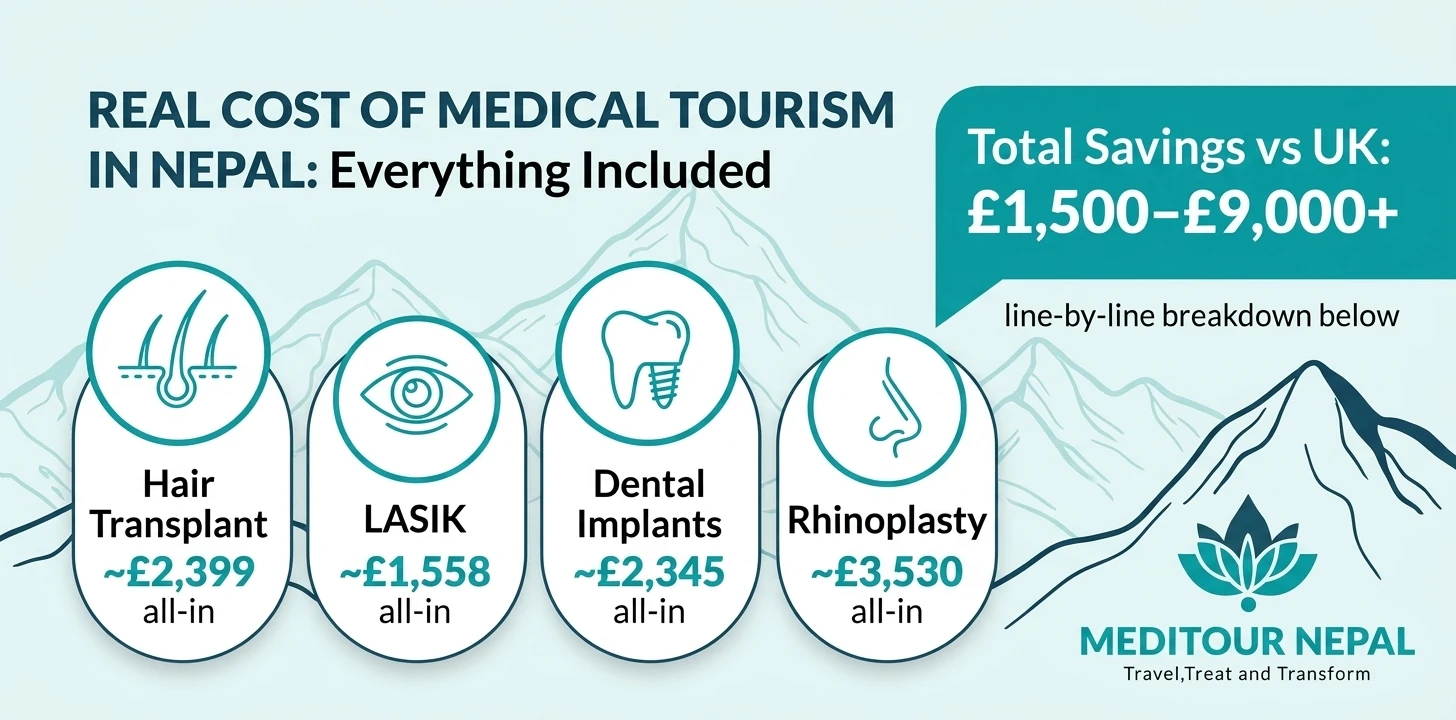
The real all-in cost of medical tourism in Nepal — flights, accommodation, food, transfers, and aftercare included. A hair transplant trip totals around £2,800. LASIK around £1,400. Dental implants around £1,900. All still saving thousands vs UK prices. Free quote with MediTour Nepal. .mw,.mw *,.mw *::before,.mw *::after{box-sizing:border-box} .mw{font-family:-apple-system,BlinkMacSystemFont,'Segoe UI',Roboto,sans-serif;color:#1a1a1a;line-height:1.7;font-size:17px;max-width:760px;margin:0 auto;padding:0 16px} .mbc{padding:16px 0 0;font-size:13px;color:#5a6472} .mbc a{color:#5a6472;text-decoration:none} .mbc a:hover{color:#0d6e63} .mbc span{margin:0 6px} .mhero{padding:32px 0 0} .mhm{font-size:13px;color:#5a6472;margin-bottom:14px} .mhm strong{color:#0d6e63;background:#e6f4f2;padding:2px 10px;border-radius:20px;font-size:12px;font-weight:500;margin-right:8px} .mw h1{font-size:clamp(26px,4vw,38px);font-weight:700;line-height:1.2;letter-spacing:-.5px;margin-bottom:20px;color:#1a1a1a} .mw h2{font-size:24px;font-weight:700;margin:44px 0 16px;color:#1a1a1a;letter-spacing:-.3px;padding-top:12px;border-top:2px solid #e6f4f2} .mw h3{font-size:18px;font-weight:600;margin:24px 0 10px;color:#1a1a1a} .mw p{margin-bottom:18px;color:#2d3748} .mct{display:inline-flex;align-items:center;gap:8px;background:#0d6e63;color:#fff;text-decoration:none;padding:12px 22px;border-radius:8px;font-weight:600;font-size:15px;margin-bottom:28px} .mct:hover{background:#0a5850} .msm{background:#e6f4f2;border-left:4px solid #0d6e63;border-radius:0 12px 12px 0;padding:20px 24px;margin:28px 0;display:flex;gap:14px;align-items:flex-start} .msm .ic{font-size:22px;flex-shrink:0;margin-top:2px} .msm p{font-size:15px;color:#0a4a43;line-height:1.6;margin:0} .msm p strong{color:#0a5850} /* Cost breakdown cards */ .mbrk{display:flex;flex-direction:column;gap:0;margin:20px 0 8px;border-radius:12px;overflow:hidden;border:1px solid #e2e8f0;box-shadow:0 1px 3px rgba(0,0,0,.06),0 4px 16px rgba(0,0,0,.05)} .mbrk-hd{background:#0d6e63;color:#fff;padding:14px 20px;display:flex;align-items:center;gap:10px;font-size:15px;font-weight:700} .mbrk-hd .em{font-size:20px} .mbrk-row{display:flex;align-items:center;justify-content:space-between;gap:16px;padding:13px 20px;border-bottom:1px solid #e2e8f0;background:#fff;font-size:14px} .mbrk-row:last-child{border-bottom:none} .mbrk-row:nth-child(even){background:#f8fafb} .mbrk-row.total{background:#e6f4f2;font-weight:700;font-size:15px;border-top:2px solid #c2e0db} .mbrk-label{color:#2d3748;flex:1} .mbrk-label small{display:block;font-size:12px;color:#5a6472;font-weight:400;margin-top:1px} .mbrk-val{color:#0d6e63;font-weight:700;white-space:nowrap} .mbrk-val.muted{color:#5a6472;font-weight:400} .mbrk-row.total .mbrk-val{font-size:18px} /* Big comparison table */ .mtw{overflow-x:auto;margin:20px 0 8px;border-radius:12px;border:1px solid #e2e8f0;box-shadow:0 1px 3px rgba(0,0,0,.06),0 4px 16px rgba(0,0,0,.05)} .mtw table{width:100%;border-collapse:collapse;font-size:14px;min-width:480px} .mtw thead tr{background:#0d6e63;color:#fff} .mtw thead th{padding:13px 16px;text-align:left;font-weight:600;font-size:13px;white-space:nowrap} .mtw tbody tr{border-bottom:1px solid #e2e8f0} .mtw tbody tr:last-child{border-bottom:none} .mtw tbody tr:hover{background:#f8fafb} .mtw tbody td{padding:13px 16px;vertical-align:middle} .mtw tbody td:first-child{font-weight:600;color:#1a1a1a} .mtn{color:#0d6e63;font-weight:700;background:#e6f4f2} .mtsav{color:#0a5850;font-weight:700} .mtnote{font-size:12px;color:#5a6472;font-style:italic;margin-bottom:28px} /* Savings hero cards */ .msavg{display:grid;grid-template-columns:repeat(auto-fit,minmax(170px,1fr));gap:12px;margin:20px 0 32px} .msav{background:#fff;border:2px solid #c2e0db;border-radius:12px;padding:18px 14px;text-align:center;position:relative;overflow:hidden} .msav::before{content:'';position:absolute;top:0;left:0;right:0;height:4px;background:#0d6e63} .msav-label{font-size:11px;font-weight:700;color:#5a6472;text-transform:uppercase;letter-spacing:.06em;margin-bottom:8px} .msav-trip{font-size:13px;color:#5a6472;margin-bottom:6px} .msav-uk{font-size:13px;color:#5a6472;text-decoration:line-through;margin-bottom:4px} .msav-save{font-size:22px;font-weight:800;color:#0d6e63} .msav-pct{font-size:12px;font-weight:600;color:#fff;background:#0d6e63;padding:2px 8px;border-radius:20px;display:inline-block;margin-top:4px} /* Hidden cost cards */ .mhcosts{display:flex;flex-direction:column;gap:10px;margin:16px 0 28px} .mhc{border:1px solid #e2e8f0;border-radius:12px;padding:16px 20px;background:#fff;display:flex;gap:14px;align-items:flex-start;box-shadow:0 1px 3px rgba(0,0,0,.04)} .mhc .em{font-size:22px;flex-shrink:0;margin-top:2px} .mhc strong{display:block;font-size:15px;color:#1a1a1a;margin-bottom:3px} .mhc p{font-size:14px;color:#5a6472;margin:0;line-height:1.55} .mib{border-radius:12px;padding:18px 20px;margin:24px 0;display:flex;gap:14px;align-items:flex-start;font-size:15px} .mib.tl{background:#e6f4f2;border:1px solid #c2e0db} .mib.am{background:#fffbeb;border:1px solid #fde68a} .mib .ic{font-size:20px;flex-shrink:0;margin-top:2px} .mibl{font-weight:700;font-size:13px;margin-bottom:4px} .mib.tl .mibl{color:#0a5850} .mib.tl p{color:#0a4a43;margin:0} .mib.am .mibl{color:#b45309} .mib.am p{color:#78350f;margin:0} .mfaq{margin:20px 0 32px;display:flex;flex-direction:column;gap:8px} .mfaq details{border:1px solid #e2e8f0;border-radius:12px;overflow:hidden;background:#fff} .mfaq details[open]{border-color:#c2e0db} .mfaq summary{padding:18px 20px;font-size:15px;font-weight:600;color:#1a1a1a;cursor:pointer;list-style:none;display:flex;justify-content:space-between;align-items:center;gap:12px;line-height:1.4} .mfaq summary::-webkit-details-marker{display:none} .mfaq summary::after{content:'+';width:26px;height:26px;border-radius:50%;background:#e6f4f2;color:#0d6e63;display:flex;align-items:center;justify-content:center;font-size:20px;flex-shrink:0;font-weight:400;text-align:center;line-height:26px} .mfaq details[open] summary::after{content:'−'} .mfaq summary:hover{background:#f8fafb} .mfaq .fans{padding:16px 20px 20px;font-size:15px;color:#5a6472;line-height:1.65;background:#f8fafb} .mcb{background:linear-gradient(135deg,#0d6e63,#0a5850);border-radius:12px;padding:40px 32px;margin:48px 0 24px;text-align:center;color:#fff} .mcb h2{font-size:24px;margin-bottom:10px;border:none;padding:0;color:#fff;letter-spacing:-.3px} .mcb p{color:rgba(255,255,255,.85);margin-bottom:24px;font-size:16px} .mcbt{display:flex;gap:12px;justify-content:center;flex-wrap:wrap} .mbw{background:#fff;color:#0d6e63;text-decoration:none;padding:13px 26px;border-radius:8px;font-weight:700;font-size:15px} .mbo{background:transparent;color:#fff;text-decoration:none;padding:13px 26px;border-radius:8px;font-weight:600;font-size:15px;border:2px solid rgba(255,255,255,.5)} .mrel{margin:32px 0 48px} .mrel h3{font-size:17px;font-weight:700;margin-bottom:14px;color:#1a1a1a} .mrg{display:grid;grid-template-columns:repeat(auto-fit,minmax(190px,1fr));gap:12px} .mrc{border:1px solid #e2e8f0;border-radius:12px;padding:16px 18px;text-decoration:none;color:#1a1a1a;display:block;background:#fff} .mrc:hover{border-color:#0d6e63} .mrc .mrt{font-size:11px;color:#0d6e63;font-weight:600;text-transform:uppercase;letter-spacing:.05em;margin-bottom:6px;display:block} .mrc .mrtt{font-size:14px;font-weight:600;line-height:1.4} .mrc .mra{color:#0d6e63;font-size:16px;margin-top:8px;display:block} @media(max-width:600px){.msavg{grid-template-columns:1fr 1fr}.mcb{padding:28px 18px}.mcb h2{font-size:20px}.mbrk-row{flex-wrap:wrap;gap:4px}} Home/ Blogs/ Real Cost of Medical Tourism Nepal Cost GuidePublished by MediTour Nepal  ·  9 min read The Real Cost of Medical Tourism in Nepal: Everything Included, No Surprises 💷 Get my free quote The number people see first is always the procedure cost. A hair transplant for £1,050. A dental implant for £500. LASIK for £400. And then the questions start: what about flights? What about accommodation? What does food cost? What about transfers, medications, follow-up care? What's the number I'm actually going to spend? This guide answers that question properly. Not with a reassuring headline figure, but with a full, honest, line-by-line breakdown of what a medical trip to Nepal actually costs — including every expense most people forget to factor in. We'll show you four real trip scenarios, what each one costs in total, and what the same treatment would cost if you had it done at home. The savings will speak for themselves. 💷 The short answer: Even accounting for flights, accommodation, food, and aftercare, medical tourism in Nepal saves UK patients between £1,500 and £9,000 depending on the procedure — and the trip itself is genuinely worthwhile. Here's exactly how the numbers work. What People Forget to Include Most cost comparisons for medical tourism quote only the procedure price. That's a useful starting point but an incomplete picture. A fair comparison includes every pound you spend. Before we get to the trip scenarios, here are the cost categories that people consistently underestimate or forget entirely: ✈️Return flightsLondon to Kathmandu return: £450–£750, depending on season and lead time. Booking 6–8 weeks ahead via Qatar Airways, Emirates, or Etihad (via Doha or Dubai) typically lands you in the £500–£600 range. Factor this in from day one — it's your largest non-medical expense. 🏨AccommodationKathmandu has a wide range. Budget guesthouses in Thamel: £15–£25/night. Mid-range hotels near major clinic areas (Lazimpat, Maharajgunj): £30–£60/night. Four-star hotels: £60–£100/night. Most patients choose mid-range and find it excellent value — think clean, comfortable, with good WiFi and staff who look after you. 🍜Food and drinkKathmandu is very affordable to eat in. A full meal at a good restaurant costs £3–£8. A coffee: £1–£2. A week of eating well — three meals a day, occasional snacks — typically costs £80–£150. Budget £15–£20 per day and you will eat better than well. 🚗In-country transfersYour MediTour Nepal coordinator arranges all clinic transfers, included in your package. Independent travel by taxi or Pathao (Nepal's ride-hailing app) is very cheap — a cross-city trip typically costs £1–£3. Budget £30–£50 for a week of independent taxi use. 💊Post-operative medicationsStandard post-op medications (antibiotics, anti-inflammatories, medicated shampoo for hair transplant patients) are included in MediTour Nepal's partner clinic packages. If additional medications are prescribed, they are available at Kathmandu pharmacies at a fraction of UK pharmacy prices. 🛂VisaNepal tourist visa on arrival: USD $50 (approximately £40) for 30 days. Pay in USD cash at the airport counter. 🛡️Travel insuranceStandard travel insurance does not cover pre-planned elective procedures. You need specialist medical travel insurance — typically £60–£120 for a week's cover including your procedure. Non-negotiable. Do not travel without it. 🎒Extras and contingencySIM card (£6), airport transfers each end (included by MediTour Nepal), cultural site entry fees (Boudhanath £2.50, Pashupatinath £6, Patan £6), shopping. Budget £100–£150 for everything else. Full Trip Breakdown: Hair Transplant (2,500 Grafts FUE), 8 Days The most common treatment MediTour Nepal facilitates. Here is a complete, realistic cost breakdown: 🦱 Hair Transplant Trip — All-In Cost FUE hair transplant (2,500 grafts)Including pre-op assessment, procedure, post-op medications, follow-up£1,050 Return flights London → KathmanduQatar/Emirates via Doha or Dubai, booked 6 weeks ahead£560 Accommodation (8 nights, mid-range hotel)£45/night, Lazimpat area, near clinic£360 Food and drink (8 days)£18/day average, eating well at local and international restaurants£144 Local transportPathao, taxis, coordinator-arranged clinic transfers included£35 Nepal tourist visa30-day, on arrival at Tribhuvan International Airport£40 Specialist medical travel insuranceIncluding elective procedure cover£90 Extras (SIM card, cultural sites, shopping)Boudhanath, Pashupatinath, Patan, Thamel£120 Total all-in trip cost£2,399 UK comparison: the same procedure (2,500 grafts FUE) at a reputable London clinic costs £7,000–£10,000. You save £4,600–£7,600 — even after the full trip. Full Trip Breakdown: LASIK Eye Surgery, 6 Days LASIK is the most efficient medical trip possible — the procedure takes 20 minutes, recovery is fast, and patients are typically free to explore Kathmandu from Day 3 onwards: 👁️ LASIK Trip — All-In Cost LASIK eye surgery (both eyes, Femto-LASIK)Including pre-op mapping, procedure, post-op drops, follow-up£450 Return flights London → KathmanduQatar/Emirates, booked in advance£530 Accommodation (6 nights, mid-range)£40/night£240 Food and drink (6 days)£18/day£108 Local transport£25 Nepal tourist visa£40 Travel insurance£75 Extras£90 Total all-in trip cost£1,558 UK comparison: Femto-LASIK (both eyes) at a reputable UK clinic costs £3,500–£5,000. You save £1,942–£3,442 — after the full trip. The flights alone are covered by the treatment saving. Full Trip Breakdown: Dental Implants (2 implants + crowns), 8 Days 🦷 Dental Implants Trip — All-In Cost 2 × dental implants (Nobel Biocare) + zirconia crownsIncluding CBCT scan, placement, abutments, crowns, follow-up£1,100 Return flights London → Kathmandu£550 Accommodation (8 nights, mid-range)£40/night£320 Food and drink (8 days)£15/day — softer diet in early days post-implant£120 Local transport£30 Nepal tourist visa£40 Travel insurance£85 Extras£100 Total all-in trip cost£2,345 UK comparison: 2 × Nobel Biocare implants with zirconia crowns at a reputable UK clinic costs £5,400–£7,000. You save £3,055–£4,655 — after every expense. Full Trip Breakdown: Rhinoplasty, 10 Days Cosmetic surgery requires a longer stay for proper recovery — 10 days is the realistic minimum for rhinoplasty. Here is the honest all-in figure: 👃 Rhinoplasty Trip — All-In Cost Rhinoplasty (open technique, board-certified surgeon)Including anaesthesia, theatre, post-op medications, follow-up£2,000 Return flights London → Kathmandu£580 Accommodation (10 nights, mid-range)£45/night — comfort matters more during cosmetic surgery recovery£450 Food and drink (10 days)£18/day£180 Local transport£40 Nepal tourist visa£40 Travel insurance£110 Extras£130 Total all-in trip cost£3,530 UK comparison: rhinoplasty at a reputable UK clinic costs £7,000–£13,000. You save £3,470–£9,470 — even after 10 full days in Nepal including all expenses. The Summary: All-In Savings at a Glance TreatmentAll-in Nepal tripUK costTotal saving Hair Transplant (2,500 grafts FUE)£2,399£7,000–£10,000£4,600–£7,600 LASIK (both eyes, Femto)£1,558£3,500–£5,000£1,942–£3,442 Dental Implants (×2 Nobel Biocare)£2,345£5,400–£7,000£3,055–£4,655 Rhinoplasty (open technique)£3,530£7,000–£13,000£3,470–£9,470 IVF (1 cycle, own eggs)~£3,800£6,000–£8,000~£2,200–£4,200 All figures use mid-range estimates. Trip costs assume mid-range accommodation and economy flights booked 6+ weeks ahead. Your personalised quote from MediTour Nepal will show your exact procedure cost before you commit to any travel. Hair TransplantTrip total: £2,399UK cost: £8,500Save £6,100~72% less LASIKTrip total: £1,558UK cost: £4,250Save £2,692~63% less Dental ×2Trip total: £2,345UK cost: £6,200Save £3,855~62% less RhinoplastyTrip total: £3,530UK cost: £10,000Save £6,470~65% less How to Reduce Your Trip Cost Further The figures above are based on realistic mid-range assumptions. There are legitimate ways to bring the total down without compromising quality or comfort: 📅Book flights further in advanceBooking 8–12 weeks ahead of your preferred travel window can reduce return flights from London by £100–£200 vs last-minute pricing. January–February and June–July (outside Nepal's peak seasons) also tend to have lower fares. 🏨Choose mid-range over premium accommodationThe difference between a £40/night hotel and a £80/night hotel in Kathmandu is largely in amenities — pool, gym, restaurant — rather than in cleanliness, safety, or proximity to clinics. Mid-range saves £280+ on an 8-night stay with no meaningful impact on your experience. 🔗Combine procedures in one tripIf you need both dental implants and teeth whitening, or a hair transplant and PRP therapy, combining them in a single trip adds very little to the procedure cost but eliminates a second set of flights and accommodation entirely. Your MediTour coordinator can plan multi-treatment trips efficiently. 🍽️Eat localDal bhat at a local Nepali restaurant costs £2–£3 and is genuinely excellent. Eating at tourist-facing restaurants in Thamel costs £6–£10 per meal. You do not have to eat local every meal — but doing so for breakfast and lunch cuts your food budget significantly without any sacrifice in quality or nutrition. ⚠️ One cost never worth cutting: travel insuranceEvery figure in this guide assumes you purchase specialist medical travel insurance covering your procedure. This is non-negotiable. A medical complication requiring additional treatment, an extended stay, or an emergency flight home could cost far more than the insurance premium. MediTour Nepal can advise on suitable policies for UK, US, and Australian patients. 💡 Get your quote before you book anythingMediTour Nepal provides a free, personalised, itemised cost estimate — procedure, accommodation options, and logistics — before you commit to any flights or travel arrangements. The quote you receive reflects the actual price your clinic will charge. There are no hidden extras added later. This is the right order of operations: quote first, flights second. Frequently Asked Questions Are these cost figures realistic or are they best-case estimates? They are realistic mid-range figures based on actual 2025 pricing — not best-case scenarios. We have used mid-range accommodation (£40–£45/night), economy flights booked 6 weeks ahead, and average food spend for Kathmandu. You could spend less by choosing budget options, or more by choosing premium hotels and business class flights. The procedure costs are from MediTour Nepal's partner clinic network and reflect what international patients actually pay — not promotional rates. What happens if my procedure takes longer than planned and I need to extend my stay? For most elective procedures, treatment timelines are well-established and extensions are uncommon. If a stay needs to extend — for example, a surgeon recommends an additional recovery day before flying — your MediTour coordinator assists with accommodation changes and flight rebooking. This is exactly the kind of situation specialist medical travel insurance covers: additional accommodation and rebooking fees arising from a medical recommendation. Standard travel insurance does not cover this. Another reason the right insurance is essential. Do I pay the clinic directly or through MediTour Nepal? MediTour Nepal is a facilitation and advocacy service, not a payment gateway. You pay the clinic directly for your procedure — by bank transfer, card, or cash — at the rates quoted in your personalised estimate. MediTour Nepal does not add a markup to clinic prices. Our service is funded by a facilitation arrangement with partner clinics that does not affect the price you pay. Are there any costs I might face after returning home? Post-operative medications prescribed in Nepal are typically included in your package. If a UK GP recommends additional medications after your return, these would be at standard UK prescription costs. For most patients, the only ongoing cost is the medicated shampoo or aftercare products for the first few weeks — inexpensive and available at any pharmacy. Telemedicine follow-up with your Nepal surgeon is included at no additional charge. Is the saving worth the trip for a single small procedure? It depends on the procedure. For LASIK, the all-in trip saving is £1,900–£3,400 — meaningful, but the smallest saving in this guide. For a hair transplant or cosmetic surgery procedure, savings of £4,000–£9,000 make the trip compelling by almost any measure. The honest answer: if the procedure cost saving alone is less than £1,500 after flights and accommodation, the financial case is weak. For most of the procedures MediTour Nepal facilitates, it is significantly stronger than that. See Your Own Numbers The figures in this guide are illustrative. Your actual costs depend on your procedure, travel dates, and accommodation preference. MediTour Nepal will give you a personalised, itemised breakdown — procedure cost, accommodation options, and logistics — before you commit to anything. 💷 Get my free quote 💬 WhatsApp us now Related guides Hair Transplant Hair Transplant Nepal vs UK: Full Comparison → Dental Tourism Dental Tourism Nepal: Implants, Veneers & More → LASIK LASIK Eye Surgery in Nepal → IVF & Fertility IVF & Fertility Treatments in Nepal →
Read More