
Most people planning their first medical trip abroad have the same question underneath all the other questions: what will it actually feel like to be there? The costs make sense on paper. The surgeon credentials check out. The savings are real. But there is a gap between knowing something intellectually and being able to picture yourself living it — waking up in a city you've never visited, recovering from a procedure, navigating an unfamiliar place.
This guide is written to close that gap. It walks through a typical week in Kathmandu as a MediTour Nepal patient — day by day, honestly, with the texture of what it is actually like. Not a brochure. Not a highlight reel. A real account of what your week might look like, from the moment you land to the morning you fly home.
The itinerary below is built around a hair transplant — our most commonly requested procedure — but the rhythm applies to dental, LASIK, and cosmetic surgery patients with minor adjustments. Where timings differ for other treatments, we note it.
The week at a glance: Day 1 — arrive and settle. Day 2 — pre-op assessment. Day 3 — procedure. Days 4–5 — rest and gentle recovery. Days 6–7 — explore Kathmandu, fly home. Seven days that change something permanently — and leave you wanting to come back.
Your flight lands at Tribhuvan International Airport — a compact, manageable airport that is nothing like the sprawling terminals of Delhi or Bangkok. The visa-on-arrival queue moves quickly. You fill in a short form, pay your fee (USD $50 for 30 days, cash), hand over two passport photos, and you're through. The whole process takes 30–60 minutes.
Outside arrivals, your MediTour Nepal coordinator is waiting with your name on a board. This is your first point of contact for the entire trip — the person who will be your guide, translator, logistics manager, and reassuring presence throughout the week. Many patients say this moment — being met, being expected — immediately makes the anxiety of travelling alone dissolve.
The drive into Kathmandu takes 20–30 minutes depending on traffic. Your first impression will likely be the controlled chaos of the streets — motorbikes threading between cars, street vendors, temple spires visible between buildings, the distant white outline of the Himalayan foothills on clear days. It is busy in a way that feels alive rather than overwhelming.
Day 1 has one job: get you settled. Your coordinator walks you through the accommodation, confirms tomorrow's assessment time, answers any questions, and leaves you to rest. Eat something light — Kathmandu has excellent dal bhat, momos, and continental options near most accommodation areas. Sleep early. Tomorrow is important.
Your coordinator collects you from your accommodation and drives you to the clinic — you'll never need to navigate there independently. The clinic itself will likely surprise you. Kathmandu's leading specialist clinics are clean, well-equipped, and professionally run in a way that matches or exceeds what most patients expect from private clinics back home. The staff are warm. The waiting areas are calm.
The pre-operative assessment is thorough. For a hair transplant, this means a detailed scalp analysis under magnification, donor area density mapping, a discussion of your loss pattern using the Norwood scale, and a personalised graft count recommendation. Your surgeon does this themselves — not a technician, not a sales coordinator. You are being assessed by the person who will perform your procedure.
This appointment is your opportunity to ask everything. How many grafts? Which technique — FUE or DHT — and why? What will my hairline look like? What are the realistic outcomes for my hair type and loss pattern? A good surgeon answers all of this without rushing. If you feel rushed, say so.
By the end of the assessment, you have a clear picture of tomorrow's procedure, confirmed timings, and pre-operative instructions — what to eat, what to avoid, what to wear. Your coordinator is present throughout and walks you back to your accommodation afterwards.
The afternoon is yours. Most patients use it for a gentle walk around their neighbourhood, a long lunch, or simply reading. The city hums around you. You are more relaxed than you expected to be.
You arrive at the clinic early — typically 8am. The pre-operative preparation takes around 30 minutes: a gown, final photographs for your records, the application of local anaesthetic to the donor and recipient areas. The anaesthetic injections are the most uncomfortable part of the entire procedure. They last about two minutes. After that, you feel nothing.
A hair transplant session runs six to eight hours for a standard graft count. During extraction, you lie face-down on a padded table while the surgeon works methodically through the donor area at the back of your head. Music plays. Staff check in regularly. Many patients sleep through significant portions of this phase.
After a break for lunch — brought to you at the clinic — you move to the implantation phase. You recline in a chair, similar to a dentist's chair but more comfortable, while the harvested grafts are placed into the recipient sites. The surgeon works with precision and focus. You can talk, watch something on your phone, or simply rest.
By late afternoon it is done. Your head is bandaged. You are given your post-operative medications — antibiotics and anti-inflammatories — and a detailed aftercare sheet. Your coordinator drives you back to your accommodation. The instruction for the rest of the day is clear: lie down, rest, eat something light, sleep. Most patients feel surprisingly well. Some feel mildly groggy from the long day. Almost none feel significant pain.
The morning begins with a return to the clinic — your surgeon checks the recipient area, inspects the donor sites, and confirms that everything is healing as expected. For the vast majority of patients, it is. You receive your medicated shampoo and a demonstration of the washing technique you'll use for the next two weeks.
By mid-morning you are cleared to move around. The instruction is to walk gently, avoid sun exposure on your scalp, and not do anything strenuous. For most people, this means a slow wander rather than a purposeful exploration — but even a slow wander in Kathmandu offers more than most cities do at full pace.
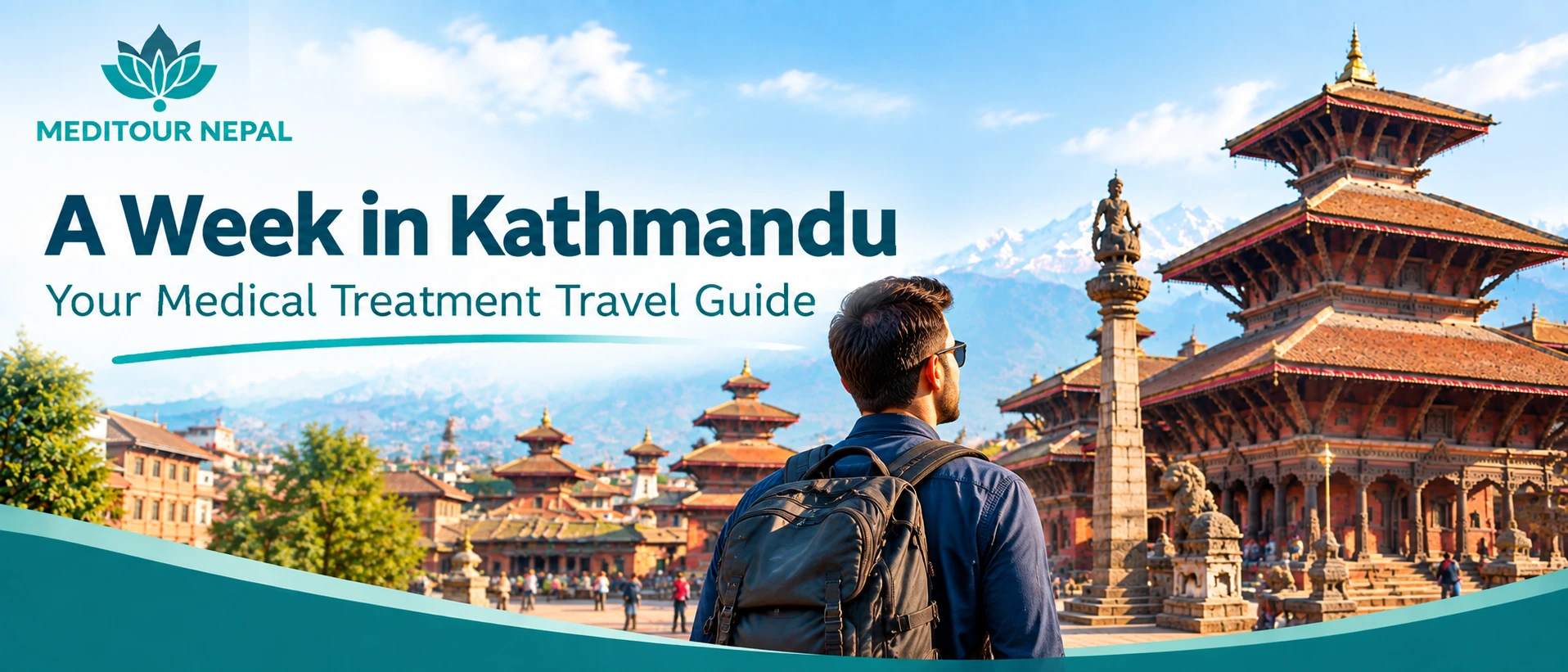
Thamel, Kathmandu's main tourist district, is likely a short walk or taxi ride from your accommodation. It is a good place to spend a quiet afternoon — narrow lanes lined with bookshops, coffee houses, and Tibetan craft stalls, the smell of incense and roasting corn, the sound of singing bowls being demonstrated outside music shops. It is not beautiful in a grand way. It is beautiful in a lived-in, layered way that rewards slow attention.
Back at your accommodation by evening, you notice something: the anxiety that travelled with you from home has largely gone. The procedure is done. The surgeon was calm and clearly skilled. Your head does not hurt. Kathmandu, which was an abstraction two days ago, has become a place with textures and sounds and a particular smell — a mixture of incense, diesel, marigolds, and something harder to name. You are, unexpectedly, enjoying yourself.
By Day 5, most patients feel well enough for a more purposeful outing. Your coordinator can arrange a taxi for the morning, or you can use Pathao — Nepal's ride-hailing app, cheap and reliable — to make your own way. The two sites that define Kathmandu for most visitors are within 20 minutes of the city centre, and they are unlike anything most Western patients have ever seen.
Return to your accommodation for a rest in the early afternoon. By evening, if you are feeling strong, the Thamel rooftop restaurant scene is excellent — Nepali, Indian, Continental, Japanese. Order momos. Order them again.
Patan — officially Lalitpur — is a separate city immediately south of Kathmandu, reachable in 20–30 minutes by taxi. Its Durbar Square is, for many visitors, the architectural highlight of the valley: a medieval royal courtyard surrounded by temples, carved wooden palaces, and stone courtyards that have barely changed in 500 years. The Patan Museum, housed in a beautifully restored Newari palace, is one of the finest museums in South Asia — genuinely worth two hours of your time.
Lunch in Patan's café district — several excellent places have rooftop views of the square. Return to Kathmandu in the afternoon for last-minute shopping: pashminas, Thangka paintings, singing bowls, and Himalayan teas make excellent gifts that pack flat. The shops around Thamel are well-stocked and prices are negotiable.
Your final evening in Kathmandu deserves a proper dinner. Several excellent restaurants near Thamel serve multi-course Nepali set meals with live music — a genuine cultural experience rather than a tourist performance. Your coordinator can recommend one suited to your energy level and dietary requirements.
Your coordinator collects you for the airport transfer. The drive back to Tribhuvan feels different from the drive in — you know the roads now, recognise the landmarks, understand what you're looking at. Kathmandu is no longer an abstraction.
At the airport, check-in for most international flights is straightforward. Keep your post-operative medications in your carry-on bag. If airport security asks about the bandaging or medications, your clinic will have provided a brief medical letter — your coordinator will have reminded you to pack it.
On the flight home, somewhere over the subcontinent or the Gulf, it becomes possible to take stock. You came for a medical procedure. You had it. The procedure went smoothly. You saw Boudhanath, and it was unlike anything you expected. You ate momos and drank tea on a rooftop with the Himalayas in the distance. You spent a week in a city most people you know have never visited, and you feel — in a way that is difficult to articulate — more yourself than when you left.
Your surgeon will follow up by WhatsApp within 48 hours of your return. MediTour Nepal stays in contact throughout your recovery. The results of your procedure will develop over the coming months. But the week itself — the texture of it, the unexpected warmth of Kathmandu, the competence of the people who looked after you — that you take home with you immediately.
Practical Information for Your Week
This guide follows a hair transplant itinerary. LASIK patients typically need 5 days (no procedure-day downtime required). Dental patients need 5–7 days depending on the number of procedures. IVF requires a longer stay — your coordinator will plan a bespoke itinerary. Cosmetic surgery recovery timelines vary by procedure. Whatever your treatment, MediTour Nepal builds a day-by-day schedule specific to your case.
Medical tourism is not without uncertainty. Procedures carry risk wherever they are performed. Kathmandu is not London — some things will be unfamiliar, and some days will feel more disorienting than others. MediTour Nepal is not a guarantee of a perfect outcome. What we can guarantee is that you will be supported throughout by people who know what they are doing, that you will never navigate a difficult moment alone, and that the clinics we work with have been chosen because we would trust them with our own families. That is the standard we hold ourselves to.
Frequently Asked Questions
What if I feel unwell during my stay in Kathmandu?
Is it safe to explore Kathmandu alone during recovery?
Can I extend my stay beyond a week?
What should I pack for a medical week in Kathmandu?
Will my MediTour coordinator speak English?
Your Week in Kathmandu Is Waiting
Medical treatment that works. A city that surprises you. A team that looks after you every step of the way. That is what a week with MediTour Nepal looks like. Start the conversation today — no commitment, no pressure, just a conversation about what you need and whether Nepal is the right place to get it.